
Job
Counterpart: Program scope and child doors · location HTML policy.
This page: Categories, services, attributes, photos, posts, Q&A, CTAs.
GBP listing fields
GBP optimization is the implementation service for the listing itself—every field Google uses for local relevance. The broader Maps, citation, and multi-location program is on Google Business Profile services. Here we audit and enhance categories, services, photos, posts, and Q&A.
Related page: Google Business Profile services.
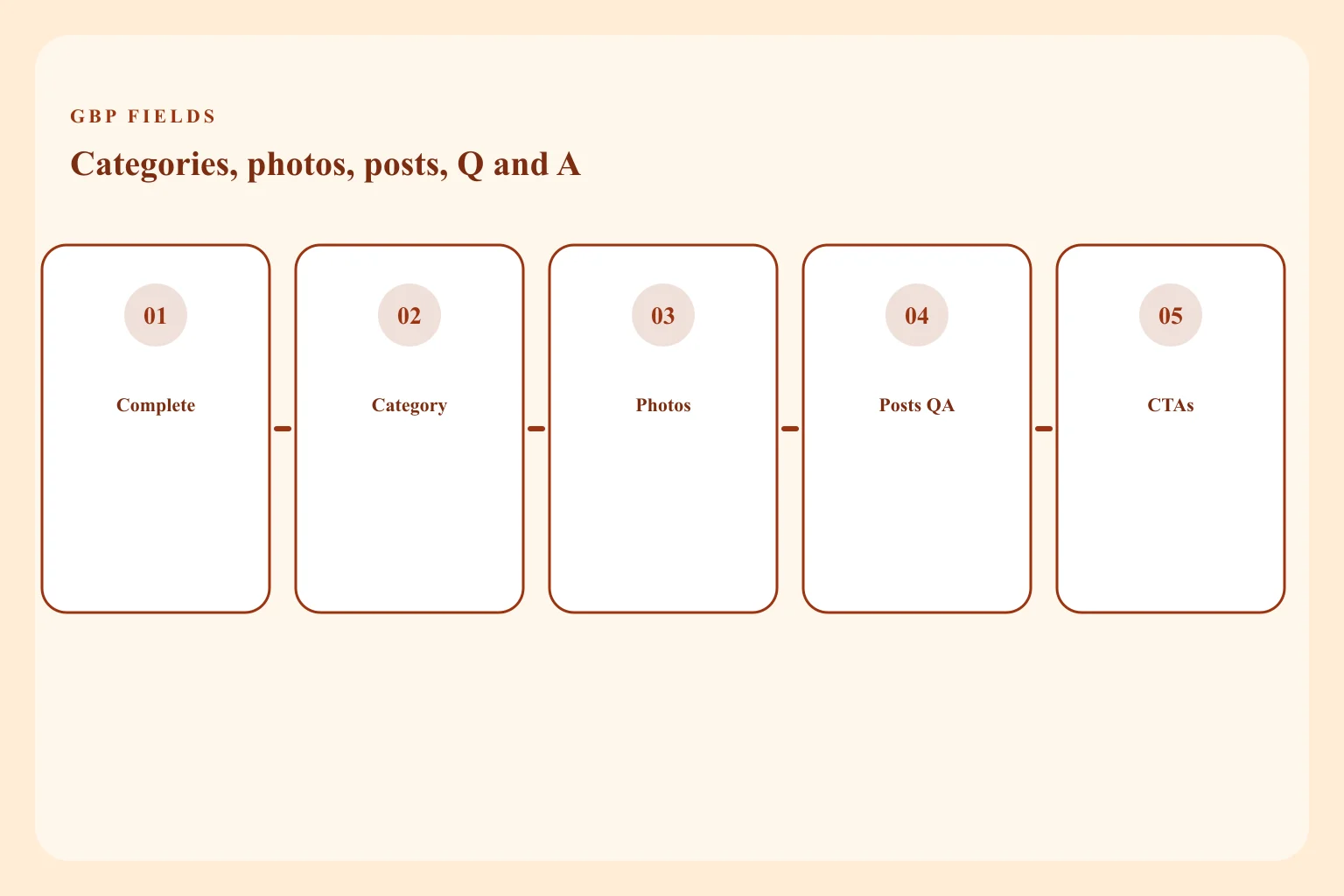
Delivery sequence
Which fields are empty, stale, or in conflict with the site.
Primary and secondary categories you can defend.
Photos, posts, and Q&A as listing content — not a blog cluster.
Booking, messaging, products, and buttons that match what you offer.
Insights after changes — not a pack ranking promise.
Field-level implementation on the listing. Not the program hub, not local SEO, not a weekly management essay.
Journey map only. No rankings, traffic, or results claims.
Split
The parent Google Business Profile services hub decides whether the listings channel is the program. Local SEO consulting owns location URLs. This page edits the listing itself.
Counterpart: Program scope and child doors · location HTML policy.
This page: Categories, services, attributes, photos, posts, Q&A, CTAs.
Counterpart: Channel fit · Presence → location URLs.
This page: Completeness → Categories → Visuals/posts/Q&A → CTA fields → Recheck.
Counterpart: GBP services · local SEO
This page: This page.
Fields
GBP optimization at SEOConsultants.ai is implementation on the listing: categories, services, attributes, description, photos, posts, Q&A, and booking or product fields. It is not a second program hub and not a location-page engagement.
Completeness is the first pass. Empty services, a missing logo, or hours that disagree with the website are field defects. We inventory fields against what you actually offer. We do not fill every optional box with keywords.
Categories are the second pass. The primary category must be the thing you are. Secondary categories must be true. Spam categories are how listings get restricted. We will not “add every nearby category” as a tactic.
Services and products on the profile should match pages or menus you can keep true. If the site does not sell it, the listing should not claim it. Alignment with NAP on the site is a check, not a reason to rewrite local SEO here.
Photos and videos are listing assets: storefront, interior, team, work you are allowed to show. They are not a content-SEO cluster. Stock that misrepresents the door is a trust defect.
Posts and Q&A are listing fields with a cadence, not a social media program. We write posts that name a real offer or hour change. We seed Q&A with questions customers already ask. We do not stuff neighborhood keywords into fake questions.
CTA fields — call, book, message, website UTM — must match how you actually want to be reached. A booking link to a dead scheduler is worse than a missing button.
Recheck
Insights after a change tell you whether discovery and actions moved. They do not prove a pack rank. We recheck completeness and whether Google kept the category we set.
Duplicates and merges are a process, not a slogan. If two listings describe one door, we follow Google’s merge or remove path. Outcomes are not guaranteed. A full diagnosis may belong on GBP audit.
Service-area businesses: hide the address when there is no public door, set service areas you actually cover, and do not invent a suite. The program decision still sits on the hub; the field configuration sits here.
Ongoing weekly posting after fields are true is GBP management. This page can start the first posts. It does not become the management URL.
Citation and review programs are siblings. We fix NAP on the listing so those programs have a source of truth. We do not build a directory list on this URL.
Boundaries
We do not reprint the hub child map as this page’s method.
We do not write location landing modules or city clones.
We do not own Maps-distance theory as an H2 spine — Google Maps SEO exists.
We do not guarantee pack movement in 8–12 weeks. Ranges you hear in the market are not an SLA.
Assistants may read complete listing facts. We do not sell AI local recommendations.
Start
Owner or manager access, a list of services you will stand behind, and photos you have rights to. That is enough for a completeness pass. It is not enough to promise a pack position.
If you do not yet know whether GBP is the channel, start on Google Business Profile services. If the website URLs are the mess, start on local SEO.
You should leave with a field checklist that was actually completed, a category decision you can defend, and a short recheck note. That is the opposite of a hub essay about “Maps as a channel.”
On this website, inbound from the hub should keep using GBP optimization. Do not point “local SEO” or “Google Business Profile services” at this slug.
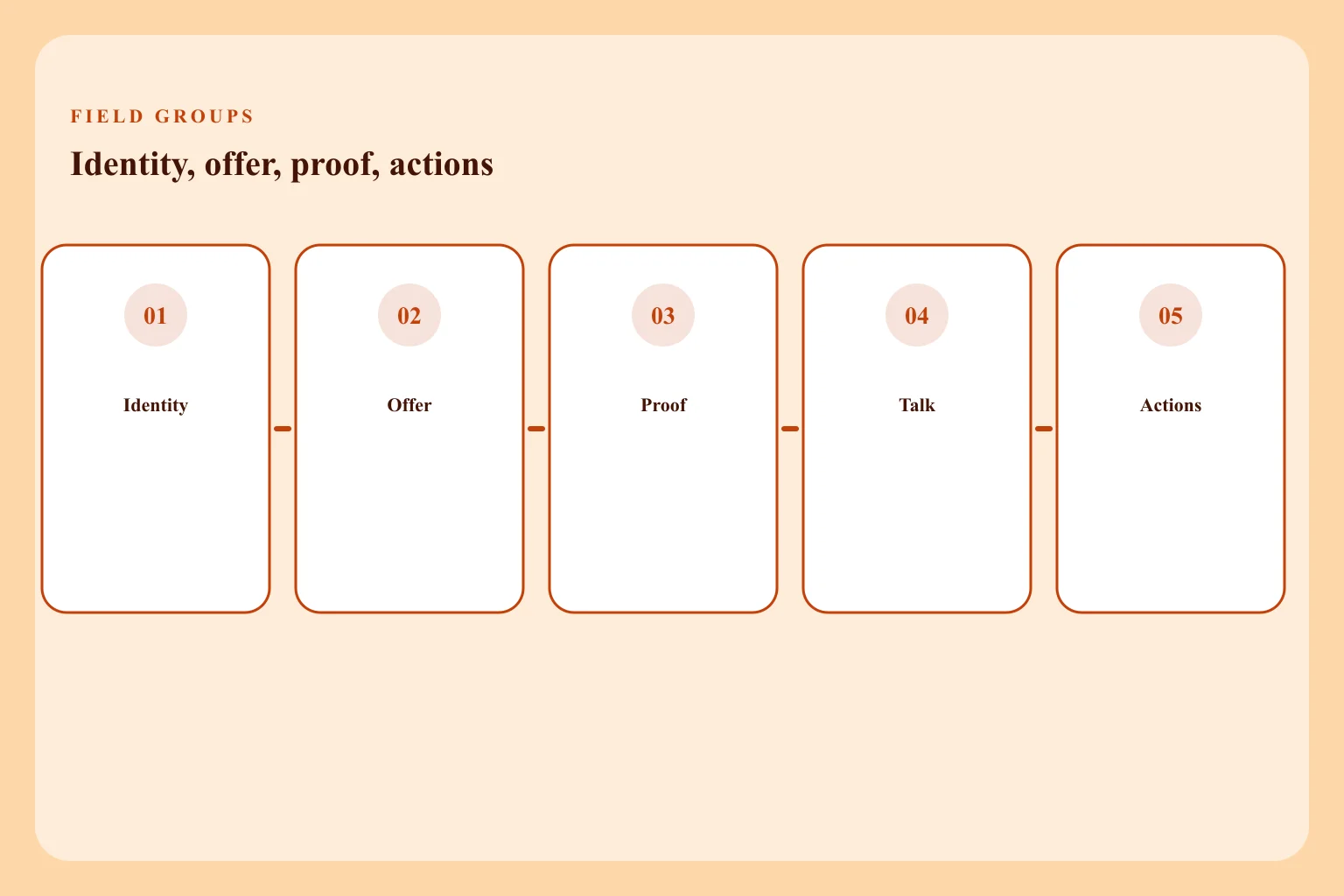
Field groups
Identity fields first: name, primary category, address or service-area setting, phone, hours. If those lie, photos will not save the profile.
Offer fields second: services, products, description. Each line should be something a customer can still get next month. Seasonal offers belong in posts, not as permanent services you will forget to remove.
Proof fields third: photos, logo, cover. We prefer the real door and real work. We refuse lifestyle stock that could be any brand on the street.
Conversation fields fourth: Q&A and the first posts. Questions should be ones you already answer on the phone. Posts should announce something that is true this week.
Action fields last: website path, booking, messaging. UTM is allowed so you can see listing-to-site clicks. It is not a reason to rewrite the whole site IA on this URL.
We stop when the listing is complete and honest. More fields for their own sake is how descriptions become keyword paragraphs. Google’s forms are not a content calendar.
If Insights later show discovery but no actions, the next question is the offer and the CTA — still fields — or whether the site document cannot convert. The second case is local SEO or the website, not another category experiment.
Description text should read like a person who works there wrote it. A paragraph of city names is a field defect. We will cut it.
Attributes and amenities are only useful when they are true on a Tuesday. Free Wi-Fi you do not have is a complaint waiting in reviews.
Product listings on the profile are for things you still sell. Out-of-stock forever is a lie. Catalog truth for a full store remains ecommerce SEO if the website is the catalog.
Opening-date and special-hours fields matter when they are wrong. We set them when you have a date. We do not invent a grand opening to look fresh.
Utm on the website button is a measurement field. It does not require a new landing page for every rooftop unless local SEO already decided that document should exist.
Q&A answers should match the phone script. If the listing says you take walk-ins and the desk does not, we change the field, not the customer.
Photo EXIF and geotags are not a ranking product we sell. We care that the picture is this door, this year, with rights cleared.
When Google rejects a category change, we document the rejection and pick the next honest category. We do not open a second listing to force the first choice.
A completeness score we invent is not a deliverable. The deliverable is the listing matching the business.
Menu or price fields, where the category allows them, must match what you charge this month. A stale price is a review waiting to happen.
Appointment URLs should open the scheduler for that door, not a corporate form that cannot book the visit.
We label photos so a future editor knows which are storefront versus work. Unlabeled dumps are how the wrong image becomes the cover after a redesign.
If a field is not available in your country or category, we skip it. Pretending every Google form is universal is how briefs go stale.
Voice-of-customer phrases from real reviews can inform Q&A. Copying review text into the description as keywords is not optimization we will do.
When hours differ by department inside one door, we use the hours the public should trust for walking in. Internal clinic hours stay off the listing. If a field cannot be saved because of a verification hold, we stop and route to audit or reinstatement instead of inventing a workaround category. We do not open a second profile to dodge the hold. A second listing to test the same door is a duplicate, not a field experiment.
Sequence
Empty, stale, and conflicting fields. Photograph rights. Hours vs site.
Primary truth, secondary only if true. No spam categories.
Real photos. Posts that name a real offer. Buttons that work.
Did Google keep the fields. Did actions move. No pack guarantee.
Not this URL
Program scope and child doors stay on Google Business Profile services.
Location URLs stay on the locked local SEO page.
Weekly ops cadence has its own child.
Full diagnosis and suspension work route to the audit child.
Explore
Questions
The hub is program, scope, and doors. This page changes listing fields: categories, services, photos, posts, Q&A, and CTAs.
Local SEO owns location documents on the site. This page does not write those URLs. It edits the Google listing.
Primary is the thing you are. Secondary only if true. We do not add nearby categories as spam.
Enough to stay true: new hours, real offers, real photos. Weekly posting as an ops cadence is GBP management. Ranges are not an SLA.
If there is no public door, hide the address and set service areas you actually cover. Do not invent a suite.
We follow Google’s merge or remove path when two listings are one door. Full diagnosis can sit on GBP audit. Outcomes are not guaranteed.
They are completeness and engagement fields. They are not a pack ranking product.
Owner or manager access, services you will stand behind, and photos you have rights to. Not a pack forecast.
GBP Optimization
Field-level Google Business Profile optimization: categories, services, photos, posts, and Q&A. Implementation service under GBP services.
GBP Optimization must name
GBP Optimization next. Not a generic visibility score.