
Job
Counterpart: Campaigns, ads, community · web cluster production.
This page: Bios, profile fields, and posts that can be found in platform search.
SMO program
SMO at SEOConsultants.ai is discoverability of profiles and posts in platform search: inventory, bio and link fields, and formats you will maintain. It is not social media marketing, not ads, and not content SEO. We do not guarantee followers or AI citations.
Related page: Content SEO consulting.
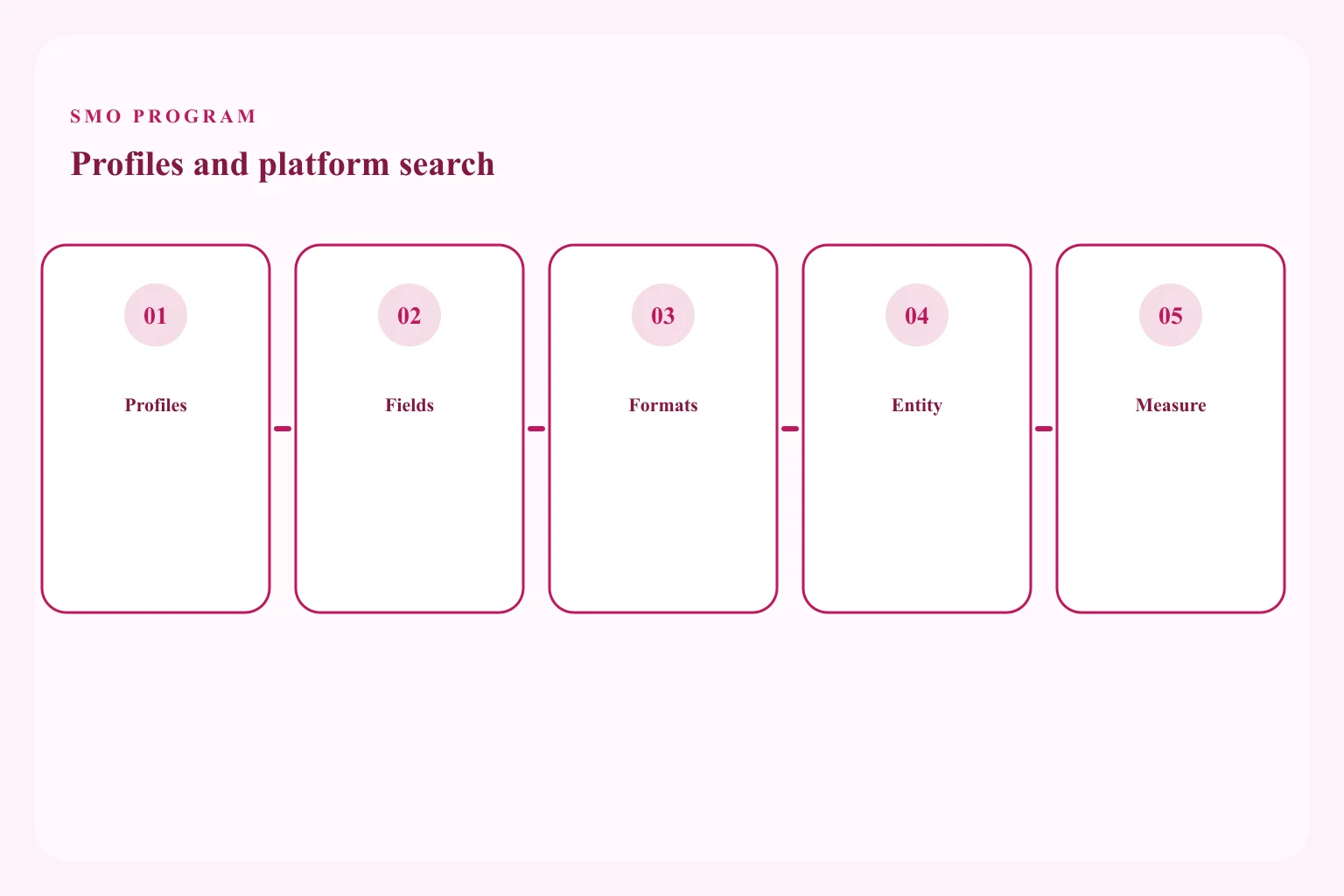
Delivery sequence
Which profiles exist and who can edit the bio.
Names, descriptions, and links platforms actually index.
Which post types you will maintain for discovery — not a campaign calendar.
The same organization name the website already uses.
Findability and useful clicks — not a follower vanity target.
Profile and social-search discoverability. Not ads, not community ops, not web content SEO.
Journey map only. No rankings, traffic, or results claims.
Split
Social media marketing includes paid and campaigns. Content SEO is the web cluster system. This hub is discoverability of profiles and posts in platform search.
Counterpart: Campaigns, ads, community · web cluster production.
This page: Bios, profile fields, and posts that can be found in platform search.
Counterpart: Calendar and spend · Demand → clusters → briefs.
This page: Profiles → Search fields → Formats → Entity consistency → Measure.
Counterpart: SMM · content SEO
This page: This page.
Scope
SMO at SEOConsultants.ai is a discoverability program for profiles and posts: inventory, platform search fields, and formats you will actually maintain. It is not social advertising and not a second content SEO page.
Profile inventory is first. Company pages, executive profiles you will stand behind, YouTube, LinkedIn, and others you will edit. Ghost profiles you cannot log into are not in the program.
Search fields are second: name, headline, about, links, and categories the platform exposes. We match the organization name the website uses. We do not keyword-stuff a bio into fiction.
Discovery formats are third. A LinkedIn article or a YouTube title can be a findability job. A daily meme calendar is marketing. Social content strategy exists as a child if the job is the calendar. This hub only says whether discovery formats are in scope.
Entity consistency is fourth. The same brand string across site, GBP, and social reduces confusion. LLM SEO owns how models describe you. We do not turn SMO into that treatise. One sentence: posts can corroborate a name; they do not buy citations.
Child doors: social media optimization for deeper profile work, platform children (LinkedIn, YouTube, and the rest) for one network, social advertising for paid, community management for community. This hub maps. It does not reprint.
Measurement is whether the profile can be found for the name and job you care about, and whether a post that was meant to be found was found. Follower counts are not the KPI unless you already defined them as the job — we usually will not.
Boundaries
We do not run ads on this URL. That is social advertising.
We do not own web clusters. That is locked content SEO.
We do not own app-store listings. That is ASO.
We do not claim social signals as Google ranking factors. Traffic and mentions can help indirectly. That is not a ranking lever we will sell.
We do not reprint “why brands choose us.”
Start
A list of profiles, who can edit them, and which names must match the site. That is enough for an inventory. It is not enough to promise reach.
If you want campaigns and spend, open SMM. If you want web coverage, open content SEO. If you want profile findability, stay here.
Platforms
LinkedIn is often the B2B findability door: company page, service language, and executive headlines that match the offer. Depth is the LinkedIn child. This hub only marks it in or out.
YouTube is a search engine that happens to be a social host. Titles and descriptions are SMO when the job is findability. The YouTube child owns that depth. Web video SEO is not this H1.
X, Instagram, and Facebook are in scope when you will actually edit the profile and when discovery on that network matters. They are out of scope when the account is abandoned. We will not write a six-network calendar to look complete.
Hashtags and keywords in posts are platform-search tactics, not a substitute for a web cluster. If the only asset is a blog, start with content SEO and reuse a fact — do not invent a social essay that contradicts the page.
Employee profiles are part of the inventory only when the company will support them. We do not scrape staff into a program they did not join.
You should leave with a profile list, a field pass, and a short list of discovery formats you will maintain. That is the opposite of a paid-social pitch and the opposite of a topical-cluster map.
On this website, inbound should keep using SMO from navigation. Do not retarget those anchors to ASO or to content marketing.
Entity
If the site says one legal name and LinkedIn says a nickname, assistants and people both guess. SMO’s job is to align the strings you control on social. GBP and the site have their own owners.
Link fields should point at a URL that finishes the job — usually the site, sometimes a location or product URL. They should not point at a campaign that dies next week unless that is the only honest destination.
We will not promise that a complete LinkedIn about box produces an AI citation. Eligibility and representation live elsewhere. This program makes the profile findable and consistent.
Pinned posts and featured modules are search fields when the platform treats them as part of the profile. They are campaign fields when they only exist to run a flight. We classify them before we write them.
Handle changes that break old links are a program risk. We record the old URL. We do not chase vanity handles as the engagement.
Creator versus company profiles are different inventory rows. Mixing them in one bio strategy is how a personal account becomes an unofficial brand page you cannot control.
Hashtag sets copied from a competitor are not research. We only keep tags you will reuse and that match the job in the post.
YouTube playlists can be a findability structure. A dump of unlisted videos is not a program. The YouTube child can go deeper; the hub only marks playlists in or out.
Link-in-bio tools are allowed when they are the honest destination. They are not a reason to skip fixing the website URL the profile already has.
Crisis posts and legal takedowns are not SMO. Community or legal owns those. We will not hide a complaint by optimizing a headline.
Reporting is name-query checks and which discovery posts were found. A vanity dashboard of impressions without a query is marketing, not this hub.
If the only ask is “post more,” the job is SMM or social content strategy. We will route instead of pretending volume is findability.
Findability
Display name versus legal name versus handle: three strings that should not invent three brands. We pick the public string and align the rest.
About length limits differ by network. We write the job in the first line, then proof, then a link. We do not paste the homepage hero into every about box.
Location fields on social are not GBP. If you put a city you do not serve, people message the wrong team. We match the markets you actually staff.
Call-to-action buttons on LinkedIn or Facebook are SMO when they finish a findability job. They are ads when they only exist to spend.
Cover images should still be readable at mobile crop. A slogan that disappears at the edges is not a field well set.
Verification badges are not a service we sell. If you already have one, we do not treat it as a ranking product.
Languages on a profile should match languages you will answer in. An auto-translated about you cannot support is a defect.
We record who owns each profile in a simple list. If ownership is “marketing sometime,” the program pauses until a name exists.
Old campaign UTMs left in the bio are stale fields. We replace them with a durable URL or an honest current campaign — not both stacked.
Employee advocacy tools are out of scope unless you already run them and only need the company page aligned. We will not bolt on a new vendor as SMO.
A competitor’s follower count is not a brief. Findability is whether a name or job query surfaces you, not whether you look busy.
When a platform search result shows an outdated tagline, that is a field ticket. When it shows no result, that is an inventory ticket. We do not treat them as the same. A renamed company that still ranks under the old string needs both strings recorded until the old handle dies.
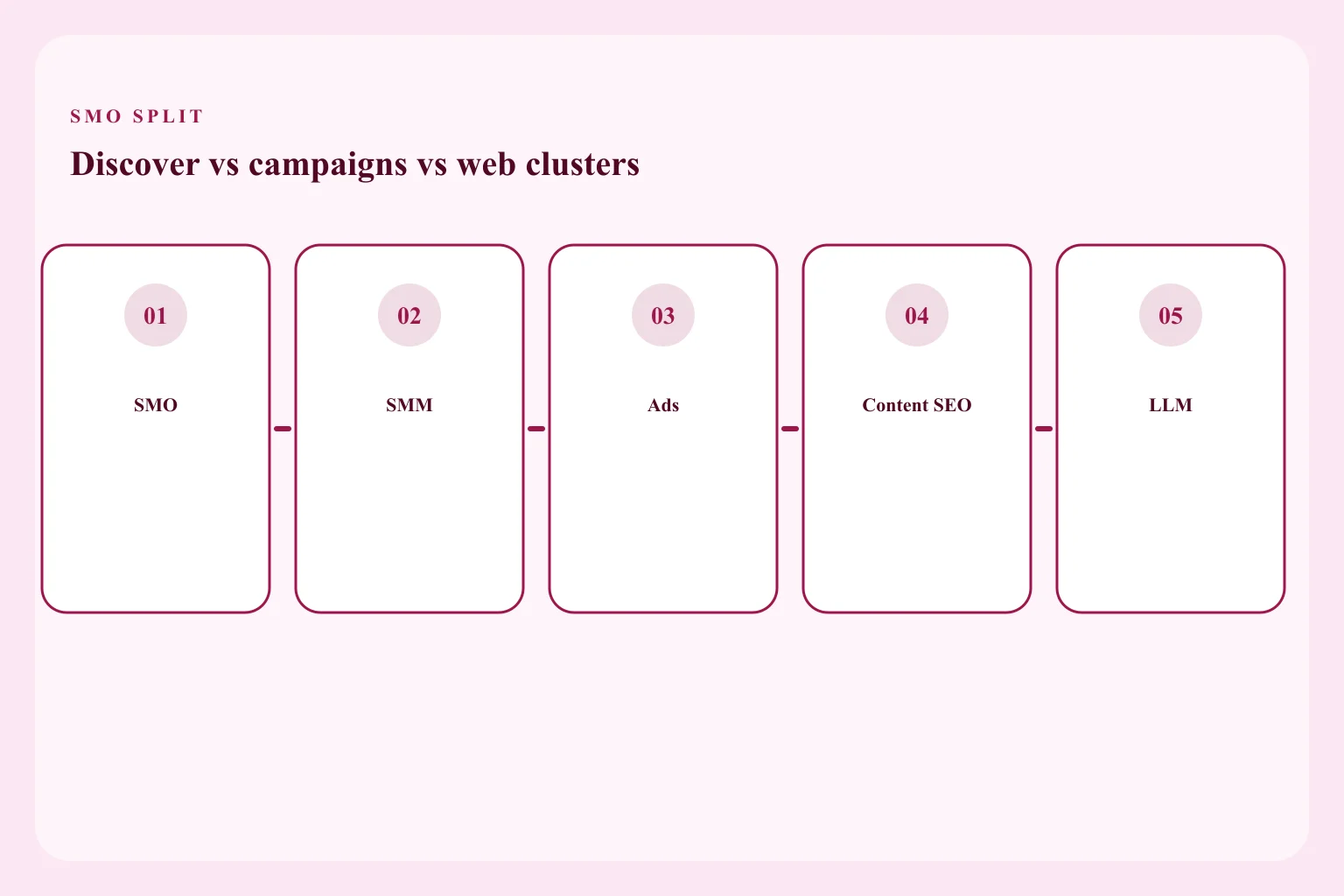
Sequence
What you can edit. Kill ghost accounts from the program.
Names, about, links. Match the site’s organization name.
Only formats you will maintain. Calendar depth is a child.
Name and job queries on the platform. No follower SLA.
Not this URL
Campaigns and paid live on SMM and ads children.
Web clusters stay on the locked content SEO page.
App stores are a different hub.
Model representation is a different practice.
Explore
Questions
SMO is profile and post discoverability in platform search. SMM includes campaigns, paid, and often community. Those jobs have their own children.
Content SEO is the web cluster system: briefs, refresh, merge. SMO does not own that inventory. A post can reuse a fact from a page; it is not a pillar.
ASO is app-store listings. SMO is social profiles. Different objects, different hubs.
Social signals are not a ranking factor we sell. Posts can send traffic and mentions. That is indirect, not a lever on this page.
The hub marks which networks are in the program. LinkedIn, YouTube, and other children hold network depth. We do not reprint four platform intros here.
No. Social advertising is a child. This hub stays on findability.
No. Posts can corroborate a name. Representation work is LLM SEO.
A profile list, who can edit bios, and the organization name that must match the site. That is enough for an inventory—not a reach forecast.
SMO
SMO program: profile fields and social-search discoverability. Not social ads, not community management, not content SEO.
SMO must name
SMO next. Not a generic visibility score.