
Job
Counterpart: Web crawl and pages · paid installs · Maps business listing.
This page: Store search → listing visibility → install conversion.
ASO program
ASO at SEOConsultants.ai is the store program: queries people type in App Store and Google Play, metadata and creatives that make the listing visible, and conversion from impression to install. It is not website SEO, not paid user acquisition, and not Google Business Profile. We do not guarantee ranks or install rate.
Related page: SEO services.
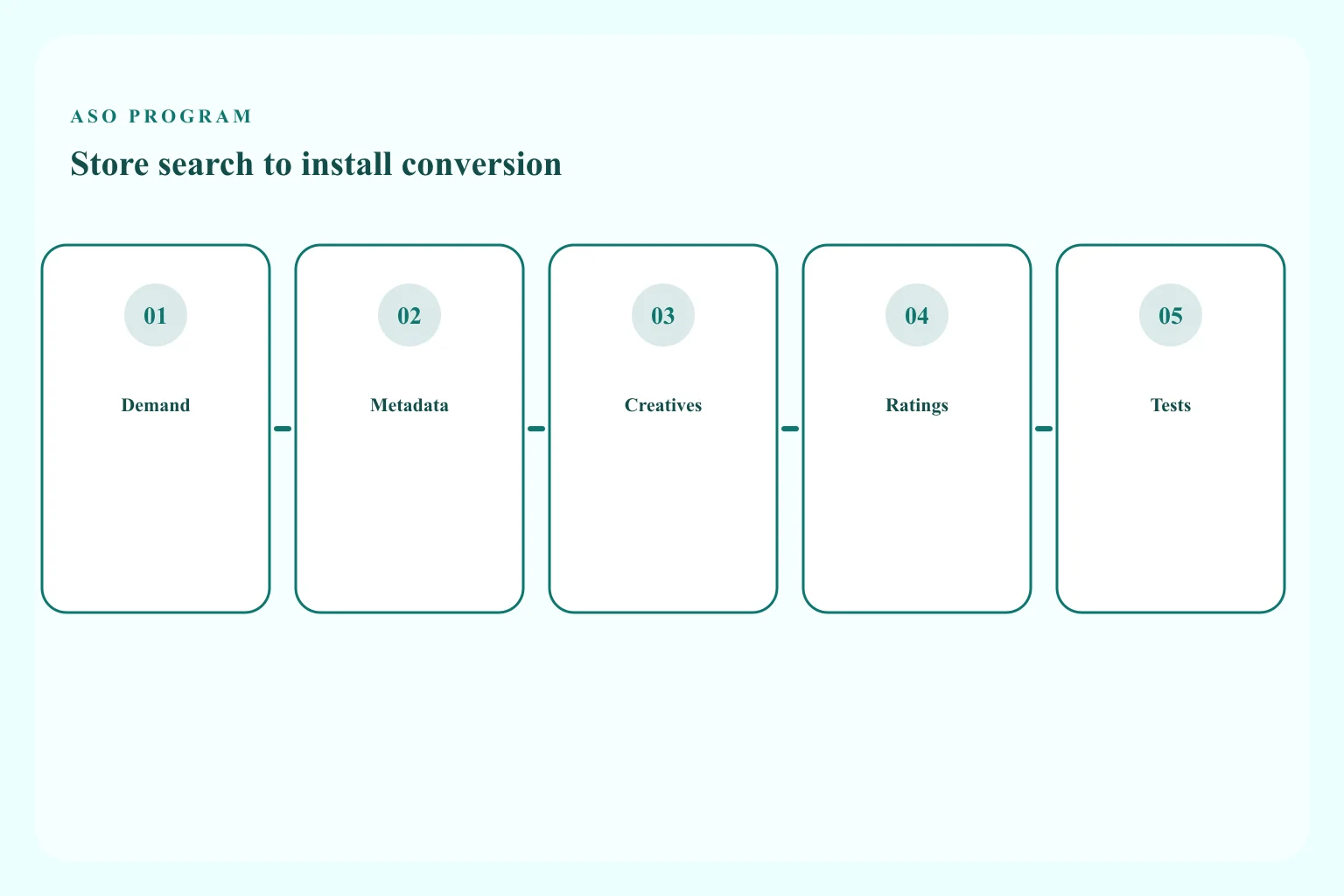
Delivery sequence
Which store queries the app can honestly match.
Title, subtitle, keyword field, short and long descriptions.
Icon, screenshots, preview video as conversion assets.
Ethical prompt and response ops — no bought reviews.
Listing experiments the store allows — no invented lift %.
Store search, listing visibility, conversion. Not web SEO, not paid UA, not Google Business Profile.
Journey map only. No rankings, traffic, or results claims.
Split
SEO services is web documents. PPC is paid demand, including app campaigns if that is the child job. Google Business Profile services is a business listing. This hub is Apple App Store and Google Play findability and listing conversion.
Counterpart: Web crawl and pages · paid installs · Maps business listing.
This page: Store search → listing visibility → install conversion.
Counterpart: Technical/content clusters · campaign structure · GBP fields.
This page: Store demand → Metadata → Creatives → Ratings → Experiments.
This page: This page.
Scope
ASO at SEOConsultants.ai is the store program: demand you can match in App Store and Play search, metadata that stays inside character limits, creatives that convert a store impression, and ratings operations you can run ethically. It is not SEO and not paid user acquisition.
Store demand is first. We research queries people type in the stores, not Google web volume pasted into a title. If the app does not do the job, we will not stuff the word.
Metadata is the second family: title, subtitle, keyword field on Apple, short and long descriptions on Play, localization when you actually ship that locale. Depth sits on app metadata, title, description, and keyword research. This hub says the family is in the program.
Creatives are the third family: icon, screenshots, preview, feature graphic. They convert visibility into installs. Depth: screenshot optimization and conversion child. We do not invent conversion-rate lifts.
Ratings ops are the fourth family: in-app prompts that follow store rules, responses to reviews, product fixes that stop repeat one-stars. We do not buy reviews. Ratings and reviews is the child.
Experiments are fifth: whatever A/B the store still allows. We report what the store reports. We do not fabricate incrementality.
Store-specific doors: App Store Optimization, Apple, Google Play, mobile app growth. The hub maps. Those URLs keep depth.
Boundaries
Web SEO cannot substitute for metadata fields the store indexes. A ranking blog post is not an App Store title.
Paid UA can buy installs while ASO is weak. Campaign structure is PPC. This hub does not become an ads account.
A Google Business Profile is not an app listing. Different object, different fields, different hub.
We do not guarantee category ranks, featured placement, or a reduction in paid CPI.
SMO can align the social name with the app name. It does not optimize the store listing.
Start
Console or Connect access, current creatives, the markets you ship, and which app is in scope. That is enough for a store-demand pass. It is not enough to promise installs.
If the product is a website, use SEO. If the job is paid installs, use PPC. If the job is a local door, use GBP or local SEO. If the job is store search and listing conversion, stay here.
Visibility
Visibility starts with a query the store will associate with your listing. Association comes from metadata and from how users already describe the app — not from a web keyword export.
A title that names the job beats a title that names a slogan the store cannot match. Character limits are constraints, not a reason to write a paragraph in the title field.
Play and Apple do not share a form. Treating them as one text box is how descriptions get truncated or ignored. The hub program includes both stores when you ship both; the children hold the field maps.
Localization is in the program only for locales you ship and will support in reviews. A translated description for a storefront you do not staff is waste.
Creatives must show the app the metadata described. A screenshot of a feature you removed is a conversion defect and a trust defect.
Ratings influence store rank and conversion together. Volume without sentiment is not the goal. We will not script five-star fiction.
You should leave with a store-query list, a metadata brief, a creative brief, and a ratings rule. That is the opposite of a web SEO checklist and the opposite of a GBP completeness pass.
On this website, inbound should keep using ASO from navigation. Do not point “SEO services” or “Google Business Profile” at this slug.
If assistants recommend apps, they are using store and web signals we do not control as a product. We will not sell an AI app-recommendation package on this hub.
Conversion
An impression that does not explain the job will not install. The first screenshot and the first subtitle line do more than a feature dump in screenshot six.
We test when the store allows a test. When it does not, we change one family at a time and read the store’s own reports. We do not publish a fake uplift table.
Paid search on the web is not a store experiment. If UA is buying the same query the listing should rank for, the handoff is “fix metadata” — still ASO — not “raise the bid” on this page.
Custom product pages and event pages on the stores are in the program only when you will staff the creative. A one-week event page that stays live for a year is a conversion defect.
In-app events and store events are not the same as web analytics sessions. We read the store’s reports. We do not import a GA4 vanity number as ASO success.
Subtitle and short-description lines should name the job a searcher typed. A slogan that needs a TV spot to decode will not convert a store impression.
Keyword fields on Apple are not a place to repeat the title. Repeating wastes characters. Play does not have the same field. The hub program includes that difference; the children hold the maps.
Localization vendors who translate features you do not ship create one-star reviews. We will not add a locale to look global.
Icon tests change recognition. We change an icon only when you will keep the brand still recognizable in a grid of competitors. A surprise icon every week is not a program.
Preview videos should show the app starting. A cinematic brand film that never shows a tap is a conversion miss.
Category choice on the store is an honesty field like a GBP category — and still not GBP. Pick the category you are. Do not hop categories to chase a weaker chart.
If the app is a wrapper for a website, ASO still owns the listing. SEO still owns the website. Paying to install a wrapper does not fix the web document.
Growth-child tactics such as referral loops are not this hub’s spine. Mobile app growth can own them. We mention the door. We do not become that page.
Promotional text on Apple is a short field with a short life. We use it for a true change, then we take it down. Leaving a launch line up for a year trains the store and the user to ignore you.
What’s New text should name what changed. “Bug fixes and performance improvements” every week is not metadata work; it is a habit. We write a real change or we skip the field.
Age ratings and content warnings are honesty fields. We do not game them. A mismatch with the binary is a store risk, not an ASO hack.
Competitor keyword scraping without using the app is how titles become lies. We only keep a term after someone on your team agrees the app does that job.
Tablet versus phone screenshot sets are different crops. Shipping a phone-only set on iPad is a conversion miss we will name.
Wear OS or watch listings are in the program only if you ship that binary. A rejected string is not reused as a screenshot caption. We will not create a watch storyboard for an app that has no watch target. If the store rejects a metadata change, we keep the rejection note in the brief so the next edit does not repeat the same string. Play and Apple rejections are stored separately because the forms differ.
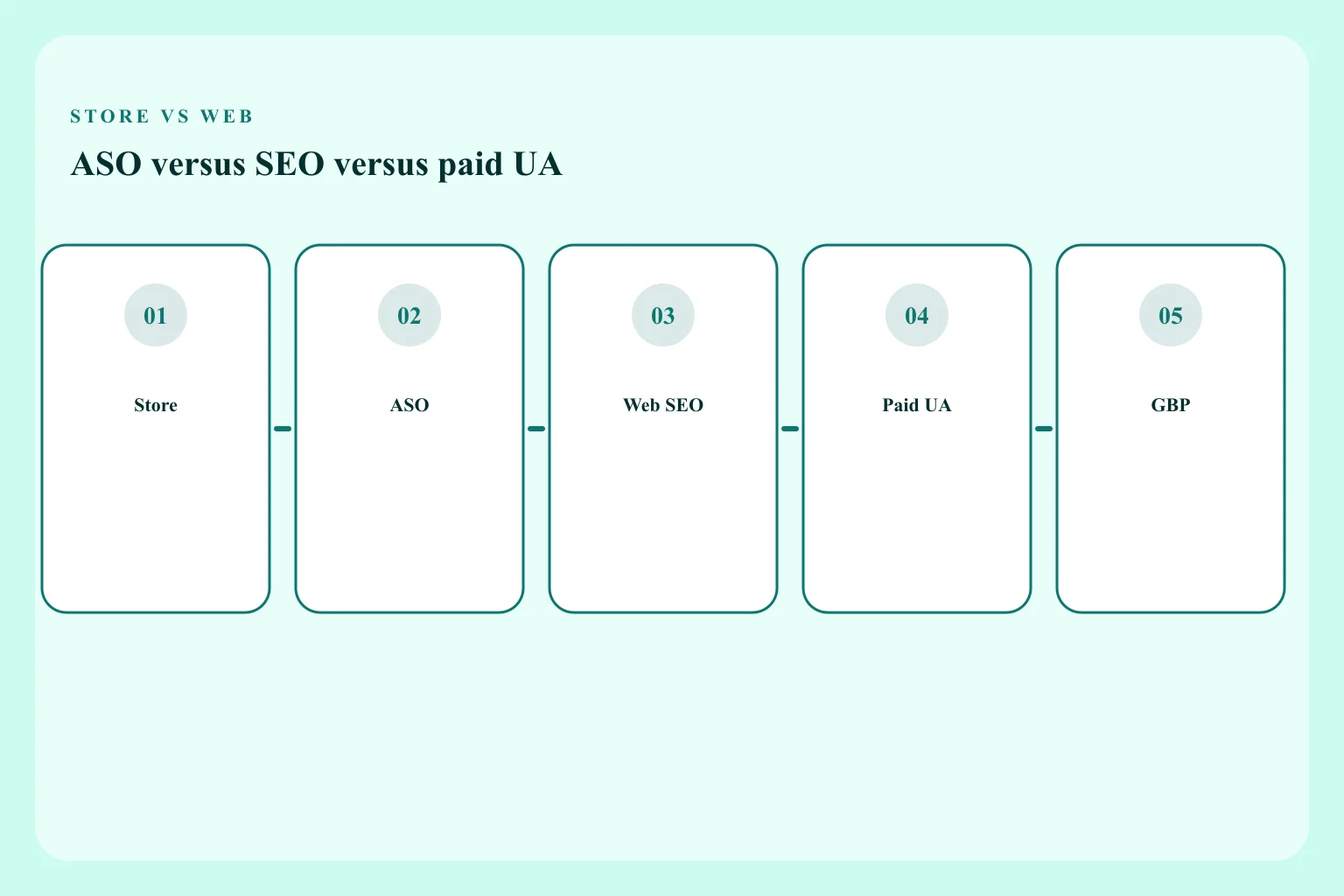
Sequence
Queries the app can honestly match in each store you ship.
Titles and descriptions inside platform limits. No web-keyword paste.
Honest screenshots. Ethical prompts. No bought reviews.
Change one family at a time. No invented CPI or rank promise.
Not this URL
Web documents stay on /seo/.
Campaign structure stays on the PPC hub and children.
Business listings are a different object.
Apple, Play, metadata, and screenshot URLs keep their depth.
Explore
Questions
ASO is store search and listing conversion inside Apple App Store and Google Play. SEO is crawlable web documents. A blog rank does not fill the App Store title field.
Paid UA buys installs. This hub programs organic store findability and listing conversion. Campaign structure stays on the PPC family.
This page is the program: store demand, metadata family, creatives, ratings, experiments. Children hold store-specific or field-specific depth. We do not reprint those intros here.
No. Stores change. We work metadata, creatives, and ratings rules. We do not sell featured placement or a CPI reduction.
The program can include both when you ship both. Field maps differ; Apple and Play children exist so we do not pretend they share one form.
No. A business listing on Maps is a different object. GBP services and GBP optimization stay on those URLs.
No. We use ethical prompts and response ops. Bought reviews are out of scope.
Store console access, current creatives, markets you ship, and which app is in scope. That is enough for a store-demand pass—not an install forecast.
ASO
ASO program: store search, listing visibility, and install conversion on Apple and Google Play. Not web SEO, not paid UA, not Google Business Profile.
ASO must name
ASO next. Not a generic visibility score.