
Object
Counterpart: A cluster to mint · a title tag · a Knowledge Panel · a WordPress plugin.
This page: Coverage: concepts and relationships the existing page must make clear.
Meaning coverage on live documents
Semantic SEO at SEOConsultants.ai is **meaning coverage on documents that already exist**: which related concepts a live URL must include so it is not a keyword island, and which entity relationships in the copy must be unambiguous. It is not [content SEO](/seo/content-seo/) (which URLs should exist), not [on-page SEO](/seo/on-page-seo/) (SERP chrome), and not [entity SEO](/seo/entity-seo/) (the named thing in the web graph).
Related page: Entity SEO (web-graph identity).
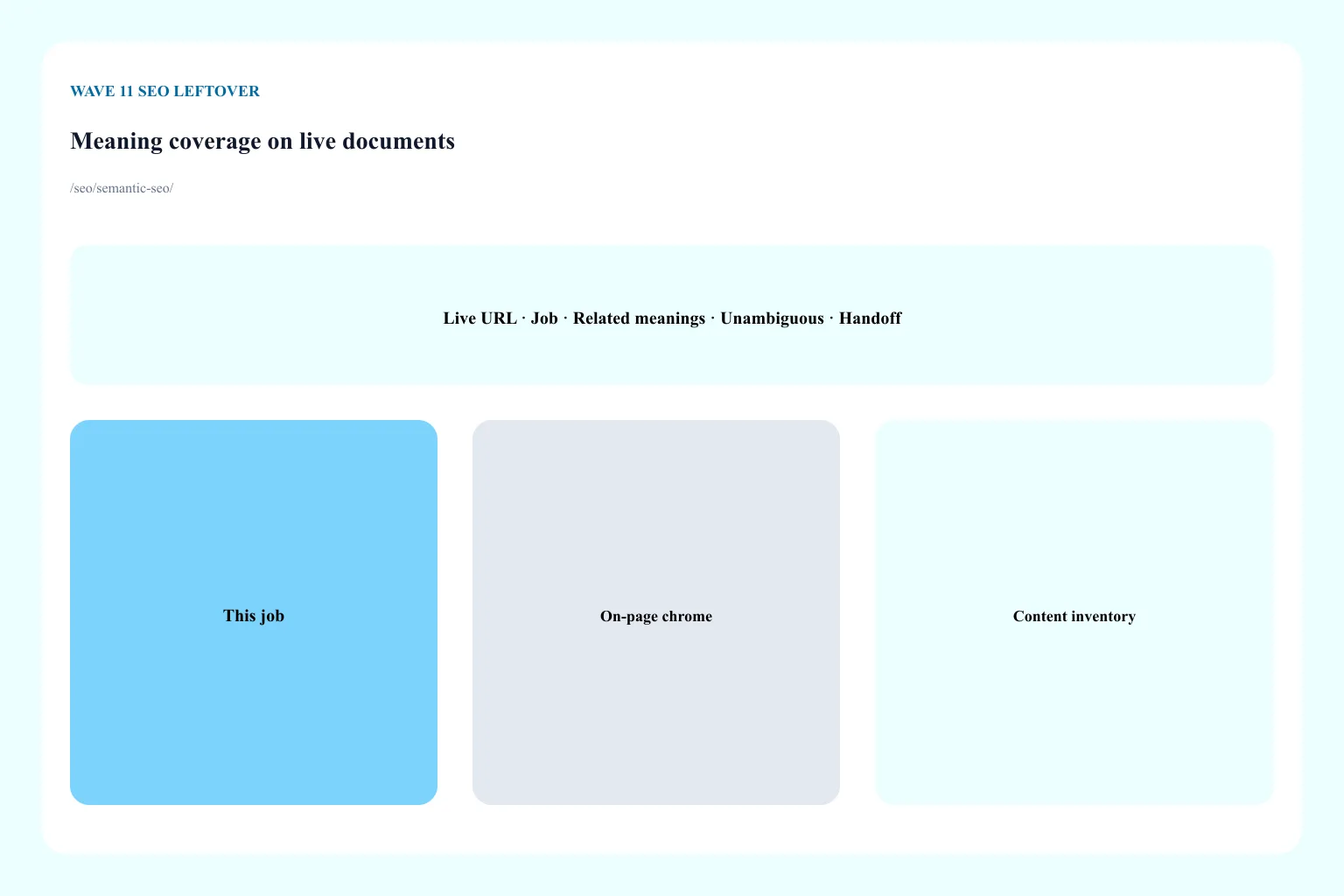
Delivery sequence
Start from a URL that already exists. Minting clusters is content SEO.
Name the job the document must complete for a searcher who already landed.
List related concepts that belong on this document so it is not a keyword island.
Make entity relationships in copy unambiguous without stealing entity-graph identity.
Handoff: new URL → content SEO; chrome → on-page; named-org graph → entity SEO.
Coverage on documents that already exist. Not inventory. Not chrome. Not the graph identity OS.
Journey map only. No rankings, traffic, or results claims.
Split
Content SEO decides whether a URL should exist. On-page SEO owns SERP chrome. Entity SEO owns the named thing in the graph. This page owns **related meanings on the live document**.
Counterpart: A cluster to mint · a title tag · a Knowledge Panel · a WordPress plugin.
This page: Coverage: concepts and relationships the existing page must make clear.
Counterpart: Demand → inventory · Job → chrome · Name → sameAs · Permalinks.
This page: Live URL → job → related meanings → unambiguous copy → sibling handoff.
Counterpart: Content · on-page · entity · hub
This page: This semantic URL.
Scope
Semantic SEO on this URL is a coverage map for pages you already published: related concepts, jargon that must be defined, and entity relationships in the prose. It is not a brief factory and not a title-tag workshop.
Buyers say “semantic SEO” when they mean entities, schema, or “write more synonyms.” Those leftover clones mixed three jobs. This page is **coverage on existing documents**. The SEO hub still chooses the program.
A paragraph that still works as content SEO is deleted. Inventory, refresh, and merge are frozen there. A coverage gap that needs a new URL is a one-sentence handoff.
A paragraph that still works as on-page SEO is deleted. Chrome can fail to match the body. Fixing the title is a handoff. Mapping missing meanings is this object.
We will not invent ranking guarantees, synonym packages, or AI-overview citation SLAs. Coverage is an editorial map, not a SERP product.
Coverage
A keyword island repeats the head term and never names the job’s adjacent meanings. The map lists those meanings as **belonging here** or **belonging on a sibling URL that already exists**.
If the sibling does not exist, content SEO owns the mint decision. Semantic SEO will not become a second hub or a topical-map SaaS reprint.
Frozen Content Strategy eight stay thesis, sequence, distribution, and draft production. This H1 will not reprint those rooms.
Programmatic templates that stamp the same three sentences on a thousand URLs are a programmatic SEO uniqueness failure, not a semantic workshop on each row.
Relationships
Copy that treats two products as interchangeable is a coverage defect. Which legal entity owns which product is entity SEO. This page only makes the **prose** stop lying.
JSON-LD identity nodes are not the spine. Schema dumps as “semantic” were leftover WordPress clones. Identity schema is entity. FAQ chrome can be on-page.
People, organizations, and products mentioned in a paragraph must be distinguishable. That is still not a sameAs spreadsheet.
LLM entity optimization stays parked. Retrieval in models is not meaning coverage on your HTML.
Chrome handoff
That mismatch is diagnosed here as a coverage hole. The title/H1 rewrite is on-page SEO. Mixing those leftover clones reprints “on-page is semantic.”
Heading outline as **meaning structure** can be listed here. Heading outline as SERP pixel chrome stays on-page.
Internal links that complete a meaning (this concept is defined there) are coverage. Sitewide related-post widgets are not a semantic product.
WordPress block markup is only in scope if the CMS mangles the document. CMS accidents live on WordPress SEO.
Honesty
This is not a second SEO hub and not a reprint of content SEO.
Migration cutovers are migration SEO. Rewriting copy after a move is still coverage, not a redirect table.
No keyword packages, no “semantic score,” no traffic multiples from adding synonyms.
Off-page stays parked. Links are not meanings.
Coverage notes
A glossary dump that never serves the page’s job is not coverage. Related meanings must earn their place on **this** URL.
Refreshing a decaying URL’s meanings is still this object. Deciding to merge two URLs is content SEO.
Industry pages stay frozen where locked. Semantic SEO will not reopen industries for manufactured inbound.
We will not use leftover FAQs about in-house teams and “which industries benefit.” Those clones die here.
Depth
Meaning coverage is the object of this page: related concepts and unambiguous entity relationships on URLs that already exist. It is not a cluster factory. It is not Knowledge Panel identity. Meaning coverage starts from a live document after SEO has chosen the program.
Content SEO owns demand, inventory, briefs, refresh, and merge. Meaning coverage will not mint URLs. A gap that needs a new URL is a one-sentence handoff.
On-page SEO owns title, H1, and first screen. Meaning coverage diagnoses when chrome promises a job the body never covers. The rewrite is a handoff.
Entity SEO owns named-thing identity in the graph. Meaning coverage makes prose stop treating two products as one. It will not own sameAs.
Frozen Content Strategy eight stay their rooms. Meaning coverage will not reprint thesis, distribution, or draft production.
Programmatic SEO uniqueness cannot be outsourced to a per-row semantic workshop. Hand-owned documents are this object.
WordPress SEO owns CMS accidents that strip structure. Remaining meanings on the HTML are still coverage here.
Migration SEO owns the cutover map. Rewriting coverage after paths stabilize can return here.
JSON-LD as a “semantic product” is refused. Identity schema is entity. FAQ chrome can be on-page.
Synonym packages and semantic scores are refused. Coverage is an editorial map.
LLM leftover stays parked. HTML meanings are not model retrieval.
Off-page stays parked. Links are not related concepts.
Industry locks stay frozen. Meaning coverage will not reopen them for inbound.
Meaning coverage has no ranking guarantee or keyword package. The deliverable is a coverage map on live URLs, with inventory, chrome, and identity left on their doors.
A live URL that ranks for a string and never defines the adjacent job is a meaning-coverage hole on semantic SEO. Minting a second URL for that job is content SEO, not this H1.
Synonym stuffing without a job is not coverage. Related meanings must earn their place on the document the searcher already opened.
Heading outlines as meaning structure can be listed here. Heading outlines as SERP pixels stay on on-page SEO.
Copy that collapses two products into one noun is a relationship defect in prose. sameAs spreadsheets stay on entity SEO.
JSON-LD dumps sold as “semantic” were leftover WordPress clones. Identity schema is entity. FAQ chrome can be on-page. Coverage is the prose.
Frozen Content Strategy rooms stay thesis, sequence, distribution, and drafts. Semantic SEO will not reprint those eight URLs.
A decaying article whose meanings drifted from the live product is still coverage on this URL. Merge versus keep is content SEO.
Programmatic templates that cannot differ by row fail uniqueness on programmatic SEO. They do not get a semantic workshop each.
WordPress blocks that strip the only heading that carried a meaning are a WordPress SEO accident plus a coverage hole here.
Migration that changes URLs is migration SEO. Rewriting meanings after the map is stable can return here. The redirect table does not.
We refuse synonym packages and “semantic scores.” Coverage is an editorial map, not a keyword invoice.
LLM leftover stays parked. Meaning in your HTML is not model retrieval.
Industry lock files stay frozen. Semantic SEO will not reopen industries for inbound.
The SEO hub still chooses the program. This page is not a second hub and not a topical SaaS reprint.
A comparison table that never names the decision criteria is a coverage hole on the live URL. A new comparison URL is inventory on content SEO if it does not already exist.
Internal links that complete a definition belong on meaning coverage. Related-post widgets that recycle the same three posts are not a semantic product.
Jargon the audience must understand belongs on this document or on a sibling that already exists. Inventing a glossary site is not this H1.
We will not sell traffic from “adding entities to copy.” Coverage is clarity on the page you already published.
First-screen promises diagnosed here still rewrite on on-page SEO. Semantic SEO does not steal chrome.
Entity collisions in a paragraph are prose. Entity collisions in the public graph are entity SEO.
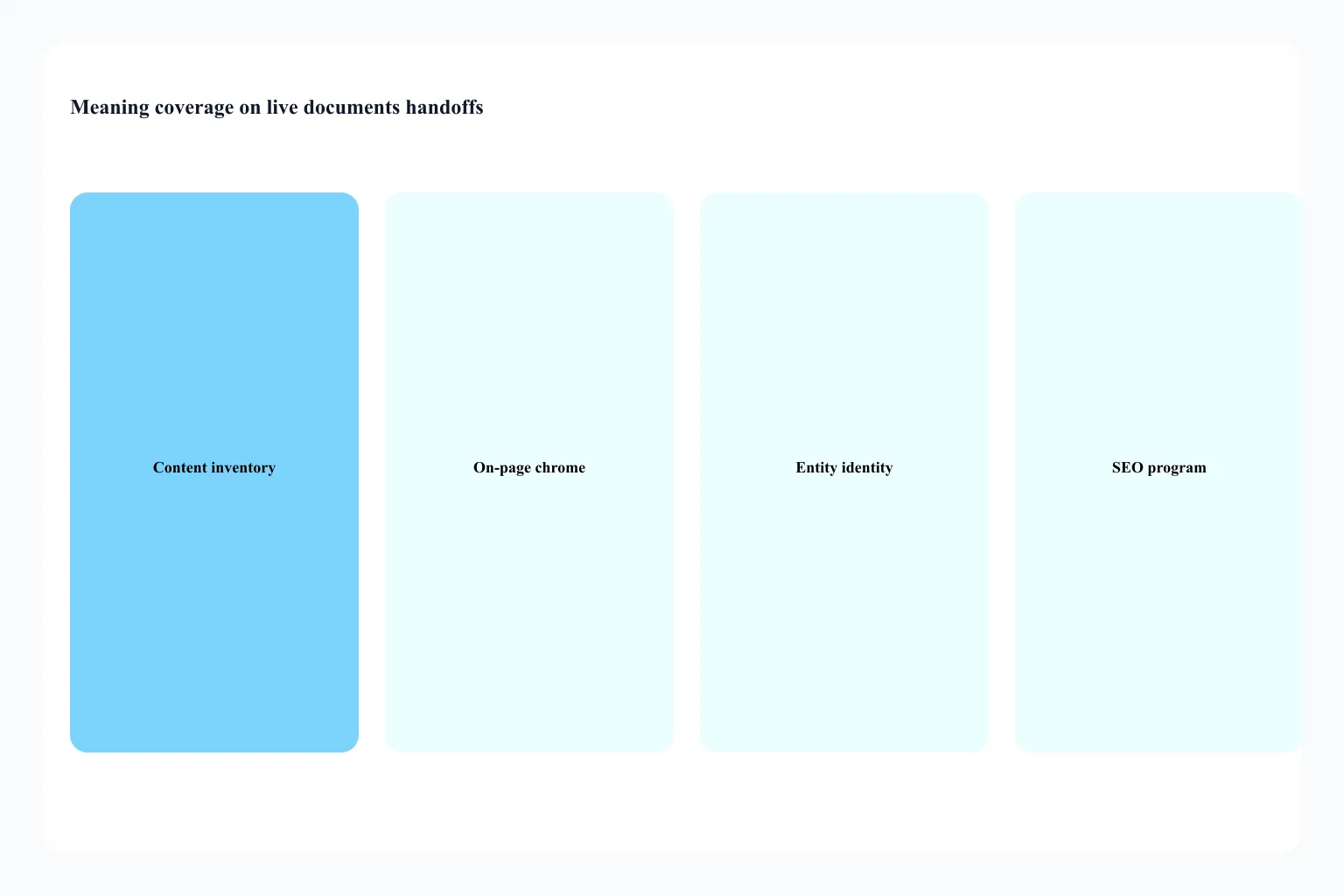
Sequence
No minting. Inventory stays on content SEO.
What the searcher must be able to conclude.
Belong here versus already exist elsewhere.
On-page and entity keep their objects.
Not this URL
Which URLs exist stays on content SEO.
Titles and first screens stay on on-page SEO.
sameAs and panel facts stay on entity SEO.
Program choice stays on /seo/.
Explore
Questions
A live URL can rank on a string and still fail as a document: missing related concepts, undefined jargon, or copy that could describe a rival product. Semantic SEO inventories **meanings that belong on this URL**, not a new cluster. [Content SEO](/seo/content-seo/) still decides whether a second URL should exist.
No. Title, H1, and first-screen chrome live on [on-page SEO](/seo/on-page-seo/). Semantic SEO may note that the first screen promises a job the body never covers. The chrome change is a handoff. The coverage map is this object.
No. Named-organization identity, sameAs, and panel fact accuracy live on [entity SEO](/seo/entity-seo/). Semantic SEO can require that copy stop treating two products as the same thing. It will not become a graph-identity OS.
Frozen Content Strategy rooms own thesis, engine sequence, distribution, and draft production as their own jobs. Semantic SEO does not reprint those eight URLs. It only covers meaning on **existing** commercial or supporting documents you already published.
No. Inventory and briefs stay on [content SEO](/seo/content-seo/). A coverage gap that needs a new URL is a one-sentence handoff. This H1 will not become a second hub or a cluster factory.
Schema as **identity** is entity SEO. Schema as FAQ or HowTo chrome can sit on on-page. Semantic SEO’s spine is the meanings in the prose and headings of the live document — not a JSON-LD dump as the product.
Semantic SEO
Semantic SEO to cover topics comprehensively, align with entity relationships, and improve relevance for modern search algorithms.
Semantic SEO must name
Semantic SEO next. Not a generic visibility score.