
Job
Counterpart: Durable organic URLs · one ad account’s search campaigns.
This page: Paid-search program: coverage, waste, and which child is in play.
Paid-search program
PPC consulting at SEOConsultants.ai is the paid-search program: which intents you will buy, which campaign family owns them, how waste is governed, and how paid hands off to organic URLs. It is not Google Ads management and not SEO services. We do not publish a minimum spend or guarantee ROAS.
Related page: SEO services.
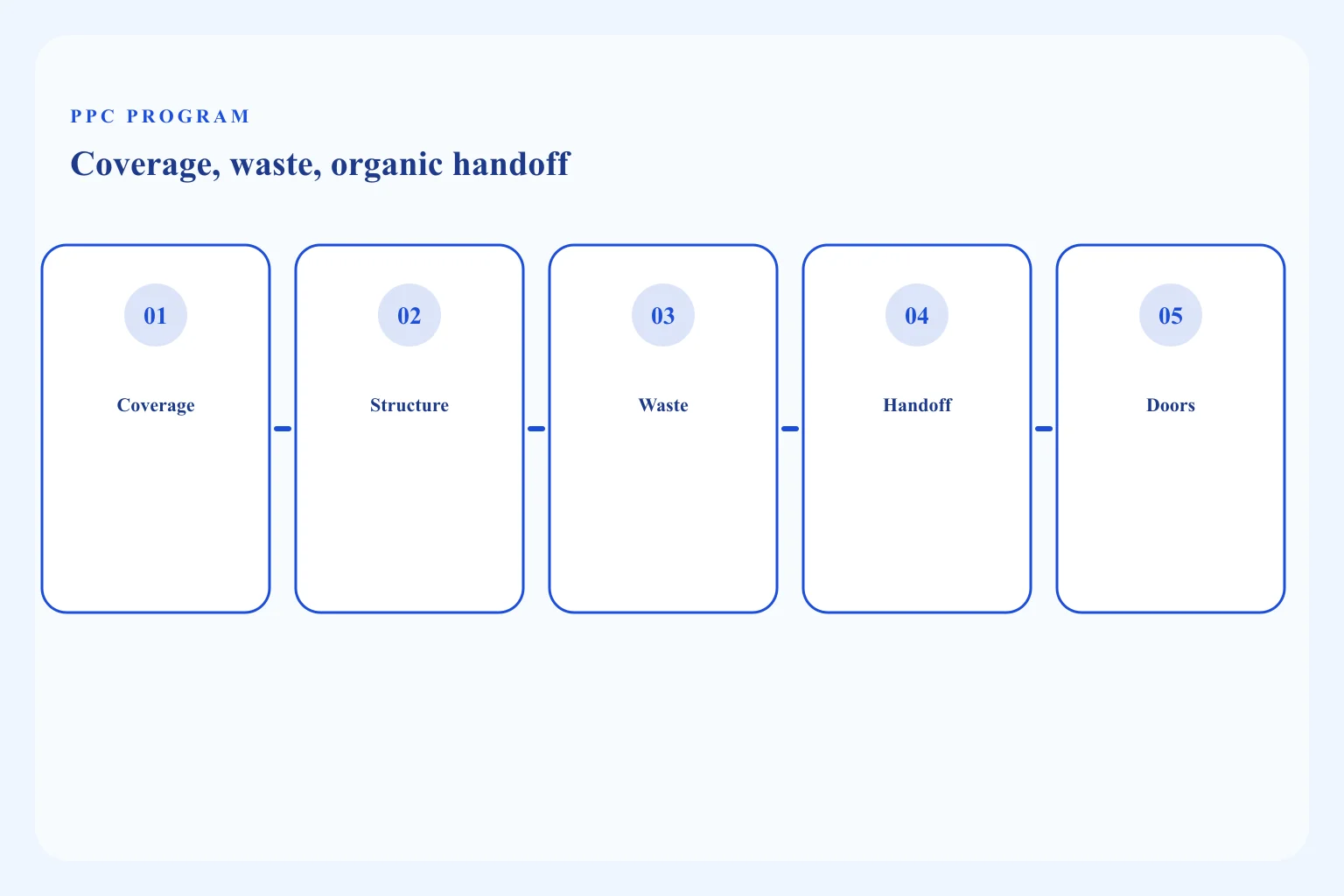
Delivery sequence
Which queries you will pay for while organic is weak or absent.
Which campaign family is the job — Search, Shopping, PMax, video, remarketing.
Negatives, overlap, and conversion definitions you can defend.
What paid learns that SEO should eventually own as a URL.
Which PPC child to open for depth.
Paid-search ecosystem hub. Not Google Ads management, not SEO, not an invented spend floor.
Journey map only. No rankings, traffic, or results claims.
Split
SEO services is the organic ecosystem. Google Ads management is one child. This hub is how paid demand is programmed across the family — without a fabricated monthly minimum.
Counterpart: Durable organic URLs · one ad account’s search campaigns.
This page: Paid-search program: coverage, waste, and which child is in play.
Counterpart: Technical/content/authority clusters · Quality Score treatise.
This page: Coverage → Structure → Waste → Organic handoff → Child doors.
Counterpart: SEO services · Google Ads
This page: This page.
Scope
PPC consulting at SEOConsultants.ai is the paid-search program: which intents you will buy, which campaign family owns them, how waste is governed, and how paid hands off to organic. It is not a Google Ads how-to and not a ranking product.
Coverage is the first artifact. We list queries you care about and mark paid, organic, both, or neither. Paying for a term you already own organically can be a brand-defense choice. It is not the default. We will not invent incrementality percentages.
Structure family is the second artifact. Search, Shopping, Performance Max, Microsoft, YouTube, and remarketing are different jobs. Depth lives on children: Google Ads, Microsoft Ads, Shopping, Performance Max, YouTube, remarketing. This hub only says which family is in scope.
Waste control is the third artifact: negatives, query themes that cannot convert, and conversion actions that match a real lead or sale. If the conversion is a thank-you page nobody defined, optimization is theatre.
Organic handoff is the fourth artifact. Paid can hold a gap while ecommerce SEO or SaaS SEO ships the durable URL. Feed facts for Shopping still need to match the HTML — that hygiene is catalog SEO, not this hub’s campaign build.
Vertical children — B2B PPC, ecommerce PPC, SaaS PPC, international PPC — own those campaign spines. We link them. We do not reprint them.
Audits and landing CRO are doors: PPC audit, landing-page CRO. Management cadence is PPC management.
Honesty
There is no published minimum ad spend on this page. A test that cannot collect useful conversions is too small to learn from — we will say that in the conversation. We will not print a dollar floor as if it were a product SKU.
ROAS and CPA are account-specific. We do not guarantee them. We do not invent pipeline influence percentages.
Performance Max is not the whole program. It is a child with asset groups and reporting limits. Search still needs a place when you must see query control.
Paid is not GEO. If ad copy appears inside an AI UI, that is a representation curiosity for LLM SEO, not a reason to redefine this hub.
Boundaries
We do not own Quality Score mechanics as the H2 spine — Google Ads child.
We do not own product-feed SEO policy — ecommerce SEO consulting.
We do not own organic cluster production — content SEO.
We do not become digital marketing. That hub is parked and thin; one contrast is enough.
We do not sell rankings.
Start
Account access, a definition of conversion you will stand behind, and the landing URLs you will use. That is enough to map coverage. It is not enough to promise a CPA.
If you only need Search campaign architecture, open Google Ads management. If you need the family sequenced with SEO, stay here.
You should leave with a coverage map, a primary campaign family, and a waste list. That is the opposite of a menu that pretends every child is this page.
On this website, inbound should keep using PPC from the SEO hub and navigation. Do not retarget those anchors to a single child.
Coverage
Brand queries are often worth defending in paid when competitors bid on your name. That is a program choice. It is not a reason to pause SEO on the homepage.
Non-brand queries with no honest landing URL should not be scaled in paid until a page exists or you accept that the ad will bounce. We would rather shrink the theme than buy a hole.
Shopping and organic product URLs must describe the same SKU. Disagreement is a feed or template defect. Campaign structure still lives on Shopping or PMax children; the catalog truth lives on ecommerce SEO.
SaaS demo queries can be paid while comparison URLs mature. The comparison templates are SaaS SEO consulting. This hub only marks the handoff.
B2B committee queries can be paid when the public role page does not exist yet. Role pages are B2B SEO consulting. We do not rebuild that sitemap here.
Remarketing is a family for people who already saw a URL. It is not a substitute for a missing organic document. If the only “strategy” is to retarget everyone, the program is a leak.
Microsoft Ads is a door when the query mix or the buying committee actually uses that network. It is not a mandatory twin of Google. The child owns the account. This hub says whether it is in scope.
International paid is geo and currency work on the international PPC child. This hub will not become a hreflang essay.
Display and YouTube are awareness families. They enter the program when the job is reach with a conversion definition you accept. They do not enter because a slide said “full funnel.”
Brand exclusions on PMax are a governance choice on this hub, implemented on the PMax child. Without them, paid can cannibalize brand Search and teach you nothing.
Shared budgets across families hide waste. We would rather see a small Search theme fail than average it into a blended number nobody can act on.
Landing URLs in the coverage map must load. Paying for a 404 is not a test. Technical access to that URL is technical SEO if the defect is crawl or render — still not this hub’s H2 spine.
Offline conversions belong in the program only when the CRM event is real. Importing every form as a sale is how ROAS becomes fiction. We will not print a fake ROAS to win a meeting.
Competitors’ brand names as keywords are a legal and policy conversation, not a default theme. We will not add them from a template.
Seasonality is a coverage note: raise or pause themes you can staff. It is not a reason to invent a promotional ROAS.
The audit child is for accounts that already exist and leak. A new account still starts with coverage, not with a 60-page retrospective.
You should be able to point at one family that is primary this quarter. If the answer is “all of them,” the hub work is not done.
Impression share is a diagnostic, not a goal we sell. Buying every impression on a weak landing is waste with a nicer name.
Device and geo splits belong in the program when conversion actually differs. Defaulting to “all countries, all devices” is how learning dies.
Ad copy on this hub is a coverage example, not a testing treatise. The Google Ads child owns variant discipline.
Agency-to-agency handoff should keep conversion history when the account allows it. Wiping an account to look busy is not a program start.
We will not use “always-on” as a substitute for a coverage map. Always-on without a query list is a retainer slogan.
If legal forbids a claim in ads, the theme is out. We do not park the claim in a sitelink to sneak it through. A coverage map that cannot name a conversion event is unfinished; we will not start spend themes until that event is written down, even if the spend itself has no published floor. Remarketing lists built from that event stay a child job once the hub has named remarketing in or out. A theme without a named owner on your side is not ready to spend. Shared inboxes do not count as an owner.
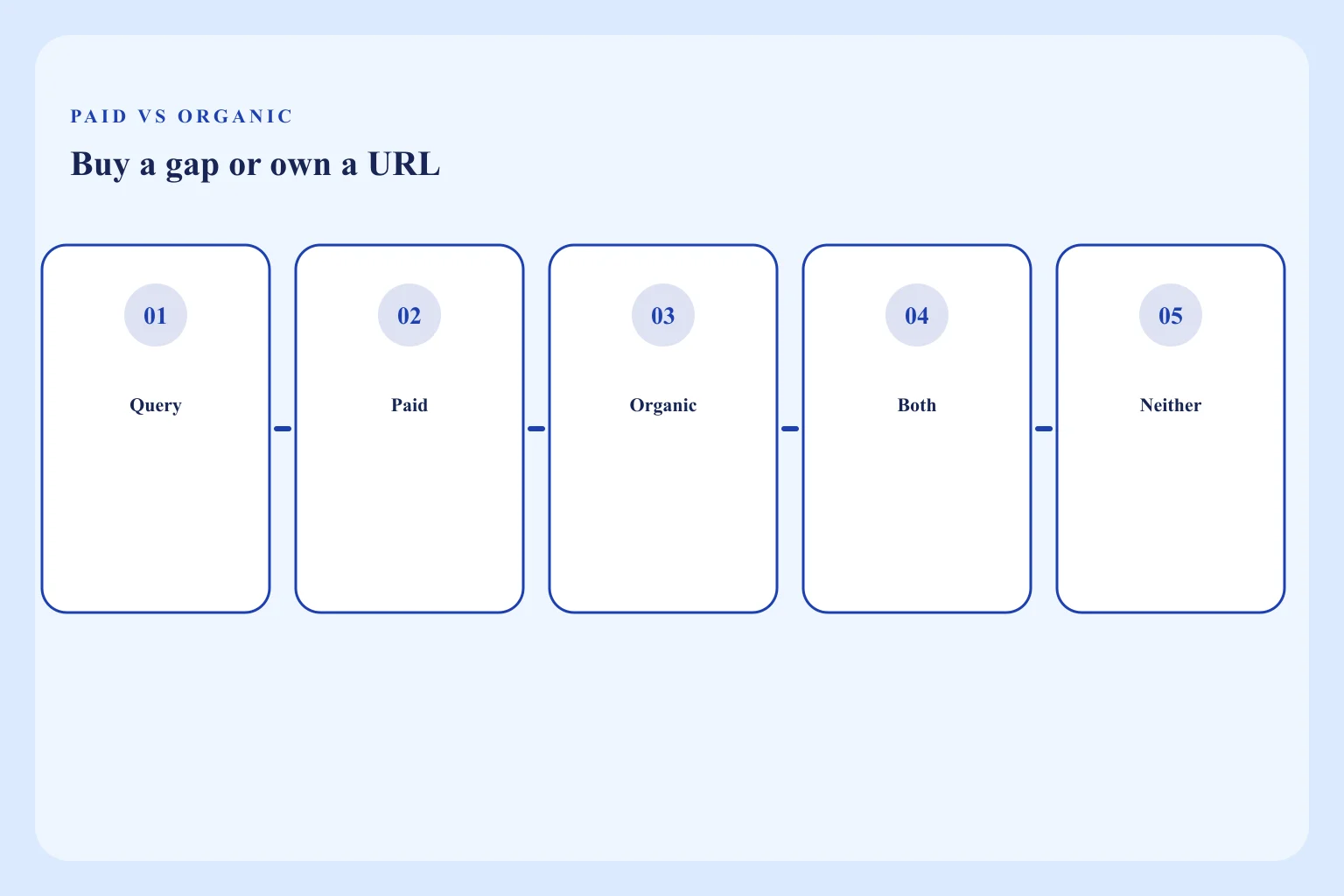
Sequence
Paid, organic, both, or neither. No invented incrementality.
Search, Shopping, PMax, video, remarketing — one primary job first.
Negatives and conversion definitions. Pause themes that cannot convert.
When a URL can own the query, reduce paid or keep brand defense only.
Not this URL
Organic ecosystem stays on /seo/.
Quality Score and ad groups are the child.
Catalog index policy is a locked Cluster 1 page.
No published dollar floor. No ROAS promise.
Explore
Questions
This page sequences the paid-search family and the handoff to organic. Google Ads management is the child for Search campaign architecture and Quality Score work.
SEO builds durable URLs. PPC buys demand while those URLs are weak or for brand defense. Neither page reprints the other.
No published floor. If a test cannot collect useful conversions, we will say it is too small to learn from. That is a judgment, not a SKU.
No. Those numbers are account-specific. We will not invent pipeline influence percentages.
A coverage map marks paid, organic, both, or neither. Paying for a term you already own is a choice, not the default.
No. PMax is a child with reporting limits. Query control still often needs Search.
No. Campaign structure is Shopping or PMax children. Catalog index and feed-to-HTML truth stay on ecommerce SEO consulting.
Account access, a conversion definition you will stand behind, and landing URLs. That is enough to map coverage—not a CPA promise.
PPC
PPC consulting: paid-search program across Search, Shopping, PMax, and related children. Complements SEO. No invented spend floor or ROAS promise.
PPC must name
PPC next. Not a generic visibility score.