
Object
Counterpart: Hreflang map · Quality Score columns.
This page: Country structure, currency, consent eligibility, localized paid copy.
Paid geo operating system
International PPC is how paid search is structured across markets: geo, currency, localized copy, and consent eligibility for remarketing. Host, hreflang, and language-return rules stay on international SEO.
Related page: PPC program.
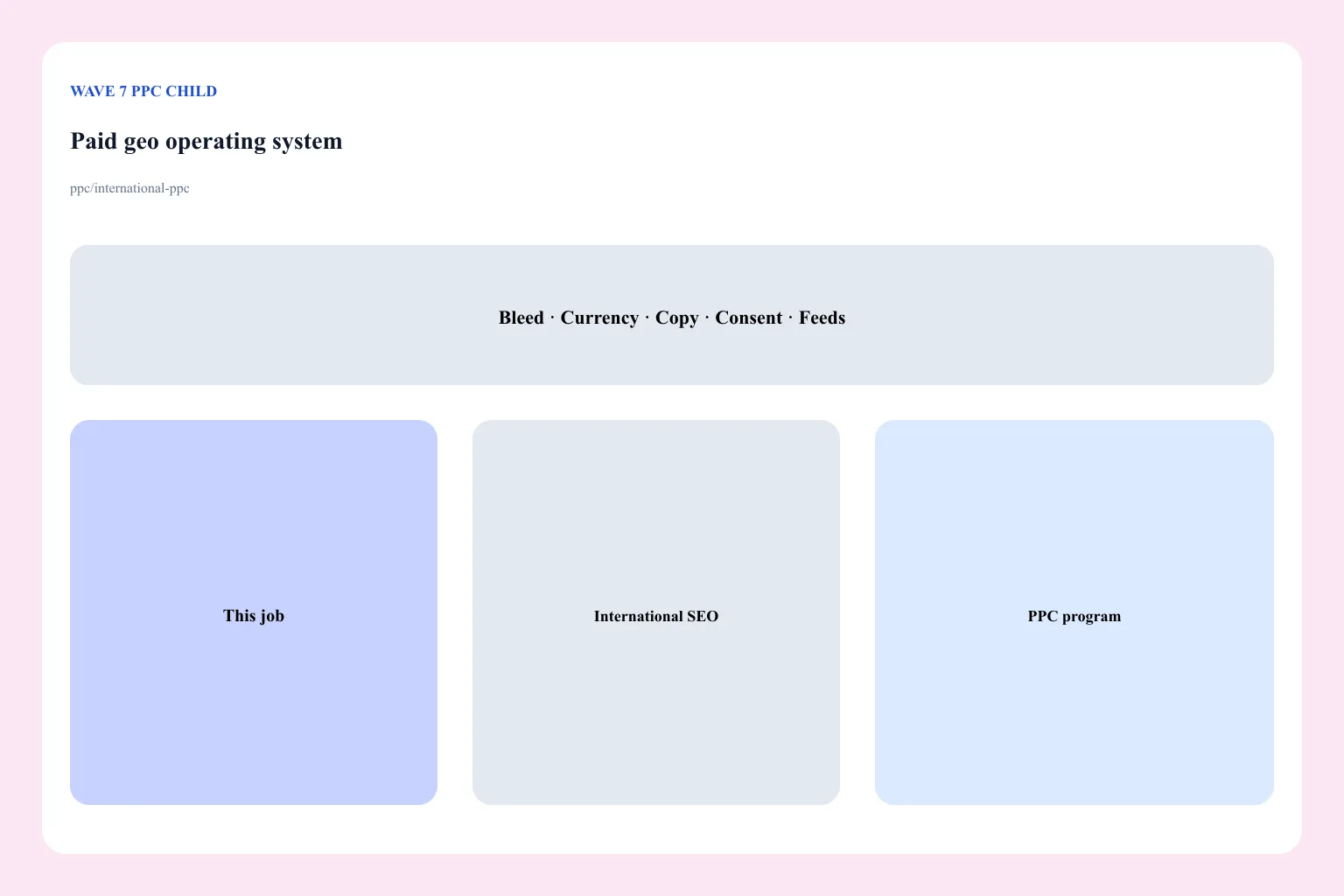
Delivery sequence
One campaign spending many countries hides learning. Split so bleed is visible.
Bids and reporting in-market. No invented FX ROAS.
Localized RSA and extensions. US paste is a draft.
Remarketing eligibility by market. List creative stays on remarketing.
Language and currency in Shopping feeds as paid eligibility, not hreflang.
Markets, currency, localized RSA, consent. Not hreflang. Not Quality Score.
Journey map only. No rankings, traffic, or results claims.
Split
International SEO owns host models, hreflang, and language-return. Google Ads owns Quality Score and conversion actions inside one Google login. This page owns **how paid is structured across markets**: geo, currency, localized RSA, and consent for lists.
Counterpart: Hreflang map · Quality Score columns.
This page: Country structure, currency, consent eligibility, localized paid copy.
Counterpart: Alternate URLs · expected CTR.
This page: Bleed visibility → in-market currency → localized RSA → consent → feed eligibility.
Counterpart: International SEO · Google Ads
This page: This international PPC URL.
Scope
International PPC is country and currency structure for ads, localized RSA, and consent that decides whether remarketing lists may run. It is not international SEO and not a Quality Score essay.
Shared campaigns that let one country spend another’s budget hide waste. This page splits structure so bleed can be seen. The PPC hub still decides which markets are in the program.
Hreflang, ccTLD versus subdirectory, and language-return rules stay on international SEO. Frozen. A paragraph that could move there unchanged is deleted.
We will not invent a timeline for “going global.” We will not print an FX-adjusted ROAS product.
Currency
Bids and conversion values should sit in the currency the market actually transacts. Mixing currencies in one campaign is a reporting lie, not a sophistication.
Account-level currency in Google or Microsoft is an account object on those children. Choosing **which market uses which currency campaign** is this OS.
Ecommerce mix (which SKUs, which storefront) stays on ecommerce PPC. This page only cares that the paid campaign is in the right geo and currency.
Copy
US campaigns copied into Europe are a draft. Headlines, sitelinks, and negatives must match how people query in that market. Search-format depth remains search ads.
Legal claims that are allowed in one country may be disallowed in another. That is a market policy note here, not a Google Ads Quality Score column.
We will not claim a localization agency SLA as a SKU.
Consent
Consent mode and cookie rules change whether remarketing and enhanced conversions may fire. Market-level eligibility is this page. Building the list and the ad is remarketing.
Microsoft UET consent issues are flagged to Microsoft Ads for the tag; the market rule still originated here.
We will not give legal advice. We will not run lists a market cannot lawfully populate.
Feeds
A feed in the wrong language or currency fails Shopping eligibility. That failure is this OS. PLA title as the ad object remains Shopping ads.
Alternate-language product URL systems are international SEO. Do not merge the doors.
PMax asset groups are not this H1. Feed-only PMax still hands groups to the PMax child.
Field notes
Location bid adjustments as a market policy are this page. Query-level geo waste inside one country is search ads.
Time-zone reporting across MCC accounts is ops-adjacent; PPC management owns cadence, this page owns why markets were split.
VAT-inclusive price in ads is a market claim constraint, not a Merchant Center treatise reprint.
Language targeting versus location targeting mismatches are bleed symptoms here.
Brand terms in a second language are still Search format; the market container is this OS.
We will not reprint Quality Score expected CTR as the spine.
Display placement by country is display ads; whether display is in the market mix is hub, then this split.
YouTube geo is the YouTube child as format; country budget bleed across YouTube campaigns is still this OS.
Holiday calendars differ by market. Seasonal structure is a note, not invented lift percentages.
Payment methods that fail checkout in a market are offer leaks for CRO, not hreflang.
Manager access that cannot see a market’s billing is an account permission on Google Ads; which markets exist is this map.
Translated keywords that mean something else in-market are negatives after a human check — search ads execute; this page required the check.
We will not claim “international always needs a separate MCC.” Structure is a conversation.
Organic international rankings are not a substitute for paid geo split. SEO stays on its URL.
Sanctioned or blocked advertising countries are a refusal, not a campaign idea.
Shared budgets that hide country waste are flagged here, then handed to management to pace.
Depth
geo-currency-consent is the object of this page: country structure, in-market bidding currency, and ads consent that decides whether lists and enhanced measurement even exist. It is not hreflang. It is not Quality Score. Budget bleed across countries is the failure mode this OS exists to stop.
One market versus many is where geo-currency-consent work starts. A single campaign targeted at “all countries” with one currency will train on the cheapest click, not the market you can serve. PPC may have allowed more than one country. This URL structures those countries so bleed is visible.
Currency and in-market bidding are the money half of geo-currency-consent. Bidding in the shopper’s currency, or at least reporting it without mixing symbols, is an ads job. We will not invent FX-adjusted ROAS. We will refuse a US-dollar campaign that pretends to operate a euro checkout.
Localized RSA and extensions are the language half of geo-currency-consent, not translated US copy pasted into every geo. Search-format pinning depth stays on search ads. Here we insist the market sees copy and phone formats that belong there. Import-from-US without adaptation is a structural finding.
Consent mode and remarketing eligibility by market are the consent third of geo-currency-consent. A list that fills in one country and stays empty in another is often ads consent, not creative. Remarketing owns list definitions. This page owns whether that market is allowed to populate lists at all.
Shopping feeds per language and currency are paid eligibility under geo-currency-consent, not hreflang return tags. Shopping ads still own PLA Merchant field recipes. International SEO owns host models and language return. This URL only requires a feed that can serve in that market’s currency and language.
Duplicate keywords across country campaigns are a geo-currency-consent hygiene issue when they share budget. They are not a global Quality Score treatise. Google Ads keeps QS inside one account. We split campaigns or budgets so a cheap geo cannot starve a market you actually sell in.
Legal landing destinations (privacy, age, regulated claims) vary by market and sit next to geo-currency-consent because the ad must land on a URL that can legally receive that click. That is not on-page SEO chrome. If the URL cannot load, technical SEO. If the offer is illegal in that country, the geo is off.
Time zones and dayparting across markets are operational notes on geo-currency-consent, not a management-retainer cadence page. Someone has to know which market’s “yesterday” they are reading. Shared dashboards that blend time zones hide bleed. Market clocks stay separate so waste is visible per country, not averaged.
Microsoft and Google may both exist internationally; geo-currency-consent still applies per account. UET consent and Google consent are not the same switch. We will not reprint UET install steps. We will say each network needs its own market-level consent and currency structure if both are in the program.
Language targeting versus location targeting mismatches are a classic geo-currency-consent leak: English ads to a country you cannot support, or location bid adjustments that fight campaign geos. Repair the structure first. Rewriting RSA copy is not a substitute for a wrong country in the account.
Payment, tax, and shipping reality constrain geo-currency-consent. If the cart cannot check out in that country, paid geo is theatre. That is a store fact, not an ecommerce mix OS reprint. We turn the market off in ads until fulfillment can complete. Invented conversion floors stay off.
Brand terms in a second language still sit inside geo-currency-consent: which campaign, which currency, which consent regime. They are not a new hub coverage philosophy. Query-auction implementation remains search ads. Market structure remains this page, including those translated brand campaigns and their separate in-market budgets.
Agency accounts that share one MCC still need geo-currency-consent per client market, not one “international” campaign template. Template imports that ignore consent will empty lists. Template imports that ignore currency will mis-bid. The diagnostic of an existing mess may start on the audit child; the OS for markets is here.
We will not write host, hreflang, or canonical policy on this URL. geo-currency-consent is ads. When the organic language version is the right return URL, international SEO owns that return. Paid may land on it; paid does not author the hreflang map or the host model.
Market structure is the international finish: geo-currency-consent that prevents bleed. Shopping eligibility and remarketing lists go to their owners. Hreflang stays on international SEO. Spend splits, CPC, and ROAS by country are unpublished rather than dressed up as a packaged country SKU for media buyers.
Sequence
Do not share learning across markets in the dark.
No invented FX ROAS.
Search ads still own pinning mechanics.
Creative stays on remarketing.
Not this URL
Hreflang and host models stay there.
Account inputs stay on Google Ads management.
Store and SKU mix stay on ecommerce PPC.
Eligibility here; lists and ads there.
Explore
Questions
Shared campaigns that let one market spend another’s learning. This page splits structure so bleed is visible.
Hreflang and host models are /seo/international-seo/. This page will not become that treatise.
Market-level eligibility is this OS. List creative remains /ppc/remarketing/.
As a draft only. Localized RSA and negatives are required. We do not claim a timeline SKU.
Bids and reporting in the market’s currency. No invented FX ROAS.
Language and currency in the feed are paid eligibility here. Alternate-language URL systems are international SEO.
No. Google Ads account inputs stay on /ppc/google-ads/.
International PPC
International PPC across Google and Microsoft with geo-targeting, localized ad copy, and multi-currency campaign structure.
International PPC must name
International PPC next. Not a generic visibility score.