
Guides
Practical playbooks for search and AI visibility
Discover a how-to, open the existing /blog/ article, then enter the matching engine if you need delivery. This hub is a chooser — the article is the guide.
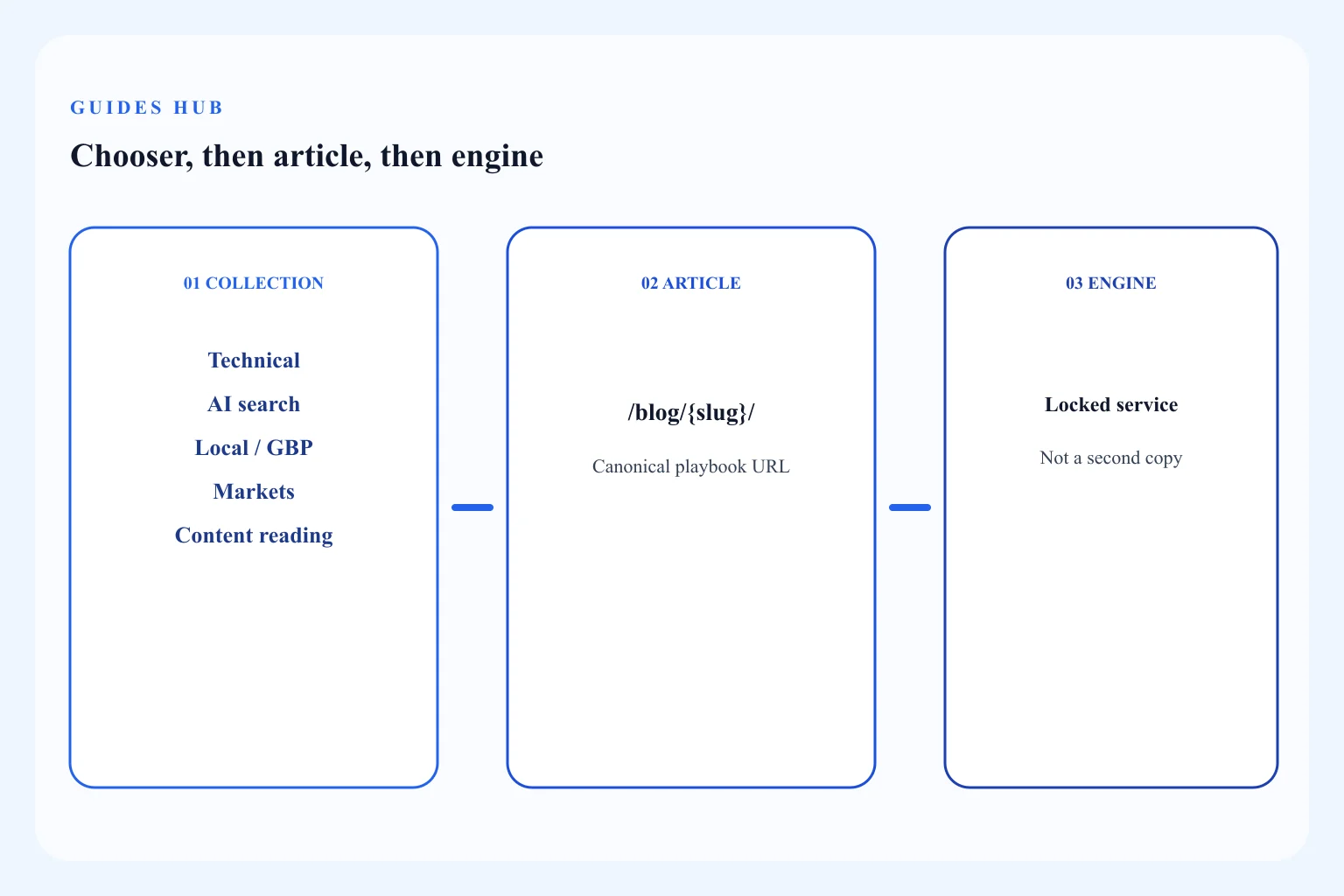
Discover → open the article → enter the engine
How to choose a playbook
/resources/ lists resource types. /blog/ lists every article,
including 5 paid-media posts that stay off this hub. This page lists practical playbooks only. Each
card opens a canonical article URL on the blog — there is no duplicate /guides/slug copy.
Pick the collection that matches the problem (technical, AI search, local, international/ecommerce/SaaS, or content reading). Then open the article. If you need delivery, use the one engine named in that collection — not this hub as a substitute for SEO services.
Not a second content OS
Guides versus content SEO and Content Strategy
Two cards below are reading on clusters and topic coverage. They are not the locked operating system. Demand map, inventory, briefs, and refresh/merge live on /seo/content-seo/. Thesis, engine sequence, distribution, drafts, and earned-attention work stay on the eight locked Content Strategy URLs. This hub will not summarize those rooms.
Directory
Find a published playbook
Does not create a search URL. PPC articles are not in this list.
No match — try another collection or the full blog index.
Collection
Technical and on-page playbooks
Crawl, render, vitals, and title/heading workflows. After the article, the engine is technical SEO. The on-page service URL is published but parked for a later architecture — /seo/on-page-seo/ is a handoff, not a rewrite from this hub.
Core Web Vitals and Technical SEO: A Practical Guide for 2026
Core Web Vitals remain a meaningful ranking and UX signal. This guide explains how to audit, prioritize, and fix LCP, INP, and CLS without chasing perfect scores at the expense of functionality.
JavaScript SEO: Ensuring Crawlers See Your Content
Client-side rendering creates invisible content for crawlers that don't execute JavaScript reliably. Learn when SSR, SSG, and dynamic rendering are worth the investment.
On-Page SEO: Optimizing Title Tags, Meta Descriptions, and Headings
Title tags and headings do more than hold keywords, they signal intent, improve CTR, and help AI systems extract topic focus. Here is how to optimize them without over-optimization.
Enterprise SEO Governance: Building Scalable Processes Across Global Teams
Enterprise SEO fails without governance. This framework covers operating models, template standards, and stakeholder enablement for global organizations.
Collection
AI search playbooks
GEO, LLM, citations, and assistant-surface reading. Engines live on LLM SEO and AI SEO — this collection does not reprint those hubs.
Generative Engine Optimization (GEO): What It Is and How to Start
GEO is the practice of optimizing for AI answer engines. This guide covers fundamentals, realistic expectations, and first steps without overhyped promises.
LLM SEO Strategy: Integrating AI Search Into Your SEO Program
LLM SEO shouldn't be a siloed initiative. Here is how to integrate AI search visibility into your existing SEO program and team workflows.
AI Search Visibility: Understanding How Answer Engines Choose Sources
AI search visibility depends on retrieval quality, source authority, and content extractability. Learn what you can influence and what you cannot.
ChatGPT Visibility: Best Practices for Brand Presence in AI Answers
ChatGPT influences buyer research at scale. These best practices improve brand visibility and accuracy in ChatGPT responses.
Perplexity Citations: How to Earn More Source Links in AI Answers
Perplexity prominently links numbered citations, a direct traffic opportunity. Learn what content formats and signals earn more Perplexity citations.
Google AI Overviews: SEO Impact and Optimization Strategies
AI Overviews are reshaping Google SERPs. Understand the traffic impact and optimization strategies for dual SERP + AI Overview visibility.
AI Citation Optimization: Making Your Content Worth Quoting
AI systems quote content they can confidently extract and attribute. These tactics improve citability without fabricating data or gaming algorithms.
Measuring AI Brand Visibility: KPIs and Monitoring Frameworks
AI visibility requires new KPIs beyond rankings. This framework covers share-of-answer, mention sentiment, and reporting for leadership.
Collection
Local and Google Business Profile playbooks
Multi-location, Maps, reviews, and profile workflows. Engines: local SEO and Google Business Profile.
Local SEO for Multi-Location Businesses: A Complete Playbook
Scaling local SEO across dozens or hundreds of locations requires templates, governance, and location-specific value, not copy-paste city swaps.
Google Business Profile Optimization: Complete 2026 Checklist
A fully optimized Google Business Profile is the highest-ROI local SEO action. This checklist covers every field and ongoing optimization tactic.
Google Maps SEO: Local Pack Ranking Factors Explained
Map pack rankings boil down to relevance, distance, and prominence. Here is what each means and how to strengthen your signals.
Reviews and Local SEO: How Ratings Influence Rankings and Conversions
Reviews influence both map pack rankings and consumer trust. Ethical acquisition, professional responses, and reputation monitoring at scale.
Collection
International, ecommerce, and SaaS playbooks
Market and catalog playbooks that still belong in organic search. Handoffs: international SEO, ecommerce SEO, SaaS SEO.
International SEO: Hreflang, Domain Strategy, and Localized Content
Expanding globally requires more than translation. This guide covers hreflang errors, domain trade-offs, and localized content that ranks in target markets.
Ecommerce SEO: Optimizing Product and Category Pages for Organic Growth
Product page SEO balances uniqueness, crawl efficiency, and commercial intent. Learn how to optimize catalogs without triggering thin content penalties.
SaaS SEO Strategy: From Comparison Pages to Product-Led Growth
SaaS SEO targets comparison queries, integration searches, and problem-aware keywords that influence demo requests, not just blog traffic.
Collection
Content SEO reading (not the operating system)
These two articles explain clusters and topic coverage as reading. The operating system — demand map, inventory, briefs, refresh/merge — is content SEO. This hub does not recreate that workflow or the locked Content Strategy pages.
Content SEO: Building Topical Clusters That Earn Authority
Random blog posts don't build authority, topical clusters do. Learn pillar/cluster architecture, internal linking, and content gap analysis.
Semantic SEO: Covering Topics Comprehensively for Modern Search
Search engines understand topics, not keyword lists. Semantic SEO ensures your content comprehensively covers subjects the way algorithms expect.
Questions
Guide directory questions
What counts as a guide on this site versus a blog article?
A guide here is a practical playbook — how to audit, sequence, or diagnose a search problem — that already lives at a /blog/{slug}/ URL. The blog index lists every article, including paid-media recipes. This hub only lists playbooks you can execute, then hand off to a published service URL.
How is /guides/ different from /resources/ and /blog/?
/resources/ is the type index (blog, guides, research, case studies, audit). /blog/ is the complete article list. /guides/ is the playbook chooser: collections, then the existing article URL. The three URLs stay separate. We do not merge them.
Why are the PPC and ads articles missing from this guides hub?
Those five posts stay on /blog/ so this page does not become a second digital-marketing destination. Paid campaign recipes sit next to PPC services, which remain parked. This hub covers organic, AI search, local, international, ecommerce, and SaaS playbooks only.
How is a topical-cluster article different from /seo/content-seo/ and the Content Strategy pages?
The cluster and semantic articles are reading. /seo/content-seo/ owns demand mapping, inventory, briefs, and refresh/merge. The eight Content Strategy URLs own thesis, engine sequence, distribution, drafts, and earned-attention ops. This hub will not reprint those rooms.
Do these playbooks replace an SEO or LLM SEO engagement?
No. A guide is a starting workflow. Delivery engines remain on /seo/, /llm-seo/, and related locked service pages. Use the collection handoff after you open the article if you need the engagement, not this directory as a substitute.
After I choose a guide, where is the matching service page?
Open the article first. Each collection names one existing engine: technical SEO, LLM SEO / AI SEO, local SEO / Google Business Profile, international / ecommerce / SaaS SEO, or content SEO for the reading pair. Articles also list related services. We do not duplicate the full services mega menu here.
Will each playbook get its own /guides/{topic}/ URL?
No. Canonical articles stay at /blog/{slug}/. This hub is a second entry point, not a second copy. We will not mint collection URLs or /guides/ duplicates.
How should teams use these playbooks for AI search without treating this hub as GEO?
Use the AI search collection to pick an article, then enter /llm-seo/ or /ai-seo/ for the engine. This page does not own citations, monitoring, or GEO delivery. It only helps you find the matching playbook URL.
Guides
Need the engine after the playbook?
Open the article first. If you still need delivery, send the site. We will point you to an existing service URL, not a new guides page.
- Playbooks stay playbooks
- Canonical articles on the blog
- Existing service URLs
- No new guides slug