
Object
Counterpart: A CVR stop-rule · Maps review inbox · star overlays on frames · hub Ratings flag.
This page: In-app review APIs, reply protocol, no-purchase ethics.
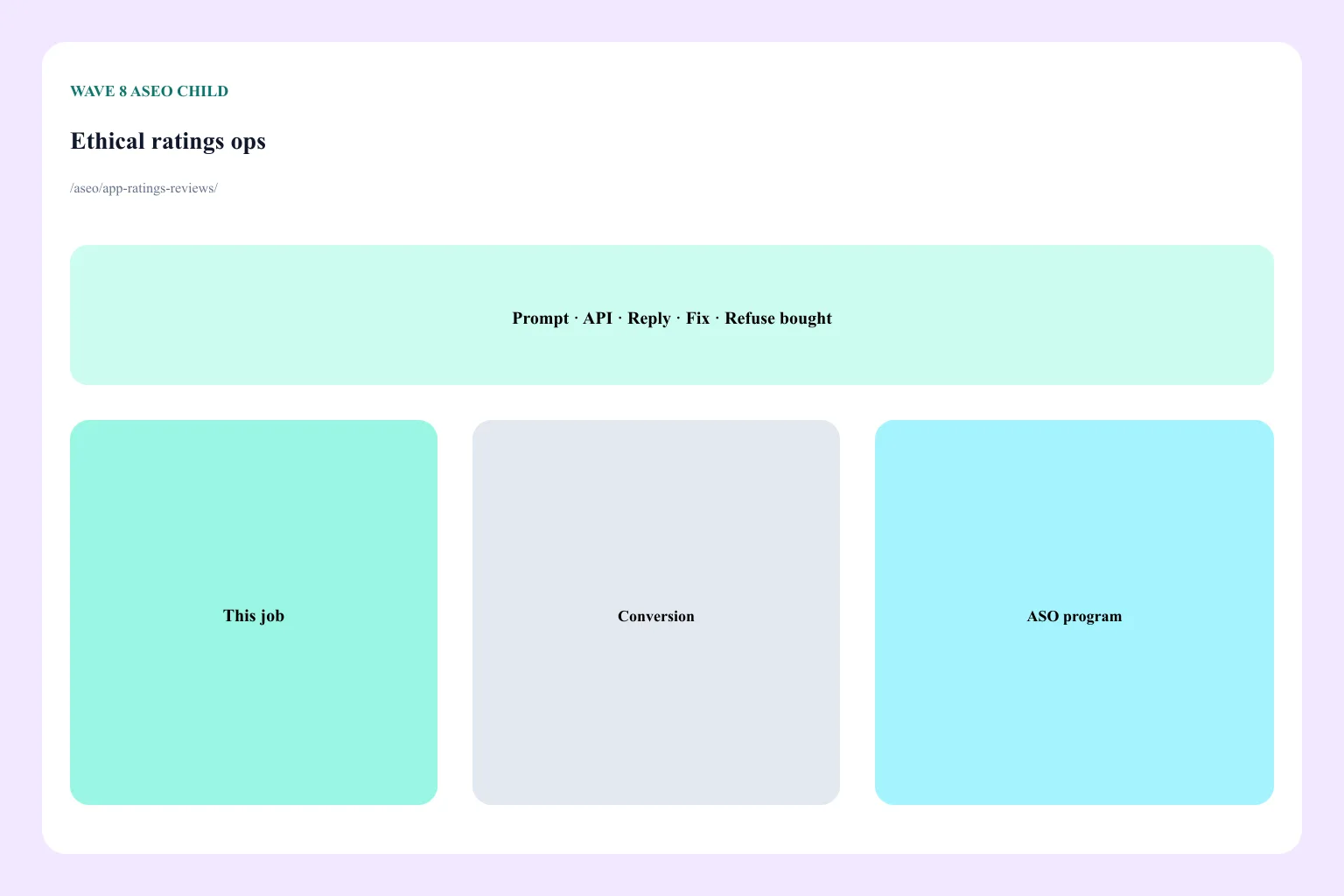
Ethical ratings operations
App ratings and reviews is ethical prompt and response operations: in-app review APIs, public replies, and a product-fix loop — not bought stars. It is not listing CVR protocol on /aseo/app-conversion-optimization/, not screenshot overlays on /aseo/screenshot-optimization/, and not Google Business Profile reviews on /google-business-profile/.
Related page: ASO program.
Delivery sequence
Prompt after a completed job, not first launch and not a random nag.
SKStoreReviewController and Play In-App Review API — not a custom full-screen trap.
Public replies on the store listing, with a tone that can be staffed.
Repeating one-star themes go to product, not to a screenshot overlay.
No purchase, no incentive, no fake volume, no 4.0 target product.
Prompt after a completed job. Platform APIs. Public replies. Product-fix loop. No bought reviews. No 4.0 SKU.
Journey map only. No rankings, traffic, or results claims.
Split
App conversion optimization reads ratings as a **listing signal** inside the funnel. Screenshot optimization must not bake stars into frames as the H1. Google Business Profile owns **Maps** review management — a different object. The ASO hub flags ratings as a family. This page owns **store ratings operations**: prompt timing, platform APIs, public replies, and the product-fix loop.
Counterpart: A CVR stop-rule · Maps review inbox · star overlays on frames · hub Ratings flag.
This page: In-app review APIs, reply protocol, no-purchase ethics.
Counterpart: Impression → install · GBP posts · first frames · Store demand → Ratings.
This page: Completed-job moment → StoreKit/Play API → public reply → fix loop → refuse bought volume.
Counterpart: Conversion · ASO · GBP (refusal) · screenshots
This page: This store-ratings URL.
Moment
App ratings and reviews is **ethical prompt and response ops** on Apple and Play. The prompt waits until the user finished a job the app actually does. First-launch nags and paywall-adjacent traps are refuses.
A completed job is product-specific: a saved file, a finished workout, a sent invoice — named with the team, not a generic “engagement score” SKU.
The ASO hub already said no bought reviews. This URL runs the ops. It does not reprint Store demand → Ratings as the whole program.
We will not sell a 4.0 average as a deliverable. Store charts are not a rating-floor product.
API
Apple’s SKStoreReviewController and Google’s Play In-App Review API are the legal, quota-limited surfaces. Custom full-screen “rate us 5 stars” chrome that bypasses those APIs is a refuse.
Quotas and system dialogs are platform constraints. We will not invent a prompt-frequency package.
Deep links that dump users into the store review composer without a completed job are still nags. Timing stays the object.
Reply
Public replies are store listing text. They are not GBP replies and not Zendesk macros pasted blindly. Staff the language of storefronts you ship.
One-star replies that argue with the user in public are a conversion defect the conversion child will feel as a signal. We write a fix path or we take the conversation off-store.
Review phrasing as **keyword research input** stays on app keyword research. This page does not mine reviews to pack the Apple keyword field.
Fix loop
When the same crash or missing feature appears in one-stars, the loop is engineering. Metadata and screenshots cannot honestly paper over it. Description honesty on app description still forbids unshipped claims.
ASO cannot repair a broken product. We will say that instead of selling more prompts.
Refuse
Purchased reviews, review-exchange networks, and in-app rewards for a star rating are out. Platform policies are the floor, not a loophole hunt.
Maps review gating on Google Business Profile is a different object. We will not run GBP playbooks against App Store or Play listings.
Field notes
Star overlays on screenshot one are not ratings ops. Asset refuse stays with screenshots.
Editorial “most loved app” badges we did not earn are honesty fails in frames and in copy.
Developer-response templates must not include competitor defamation. That is legal, not occupancy.
Kids and regulated categories constrain whether you may prompt at all. That is a stop, not a growth hack.
Deletion requests and flagging abuse are console tools. Play versus Apple moderation UIs stay on those store children; the **ethics** stay here.
SMO comments are not store reviews. Do not treat Instagram DMs as this H1.
Web Trustpilot widgets are not Apple ratings. SEO pages do not replace store stars.
Paid UA can buy users who one-star a mismatch. Campaign honesty stays on PPC; the reply still happens here.
We will not claim review volume as a guaranteed rank lever with a number.
What’s New can mention a fix that one-stars named. Writing that sentence is description copy; the loop origin is this URL.
LLM-generated review replies that hallucinate a refund policy are refused. `/llm-seo/` stays parked.
Referral “leave a review to unlock” is an incentive refuse, even if growth owns invite loops.
Dual-console reply staffing is an engagement calendar topic on app store optimization. The reply **protocol** is here.
In-app event prompts that fire during onboarding are first-launch nags by another name.
We will not import GBP review scores into store reporting as a blended average.
Conversion may pause listing tests when one-star velocity spikes. That stop-rule is protocol; the spike diagnosis is this ops page.
Depth
In-app review prompt APIs are the object of this page: SKStoreReviewController on iOS, Play In-App Review API on Android, public replies, and a product-fix loop, with a refusal of bought reviews. They are not screenshot star overlays. They are not GBP. In-app review prompt APIs are store ratings ops.
Prompt timing for in-app review prompt APIs is after a completed task the person chose, not on first launch and not as a paywall ambush. Quotas and system sheets are platform constraints, not a rating-average product we invent. In-app review prompt APIs ask; they do not buy stars or farm replies.
Public replies sit beside in-app review prompt APIs as the store’s visible response surface. A reply is not listing long-description copy. App description optimization writes Play/Apple listing copy objects. Replies stay ratings ops. We do not keyword-stuff a one-star thread.
The product-fix loop is why in-app review prompt APIs are not a vanity machine. Recurring crash complaints are engineering work, not another prompt. If the binary is broken, in-app review prompt APIs should wait. Prompting through a known defect is an ethics finding on this URL.
Bought reviews, farms, and incentivized five-stars are refused by in-app review prompt APIs as policy and as practice. We will not sell a rating. ASO already put ratings in the program family. This child implements ethical prompts after that door, not a marketplace for stars.
Google Business Profile reviews are not in-app review prompt APIs. Maps listings are a different surface. Store ratings live on Play and Apple. Anyone asking to “manage app reviews like GBP” is sent to the Maps product, not this H1. In-app review prompt APIs stay inside the binary.
Screenshot storyboard assets must not fake stars. Screenshot optimization owns frames, icon, preview, and the Play feature graphic. Overlaying an invented average on frame one is both a creative cheat and a ratings lie. In-app review prompt APIs do not storyboard. They prompt and reply.
Impression-to-install protocol is not in-app review prompt APIs. App conversion optimization owns the listing funnel before install. Prompts happen after the person already has the app. Mixing those jobs produces “CRO” that is actually a review beg on the product page.
Play Console listing experiments are not in-app review prompt APIs. Google Play optimization runs listing tests. Play’s review API is still ratings ops on this URL. An experiment that changes screenshots is creative plus protocol. An experiment that changes when you prompt is this object.
The App Store Connect keyword field is not in-app review prompt APIs. Apple App Store optimization packs hidden terms. Review text may later feed app keyword research as language input. Mining language is research. Prompting is ratings. Keep the split.
The dual-console calendar may avoid shipping a prompt-policy change beside a listing freeze. App store optimization sequences Play and Apple as one engagement. In-app review prompt APIs still own the system sheets. Calendar is not a reason to reprint ratings ops on the both-store page.
Visible title string changes are not in-app review prompt APIs. App title optimization owns the store name as brand plus job. A rename may confuse reviewers; that is a title-plus-support finding. We do not fire in-app review prompt APIs more often to paper over a rename.
Field allocation OS is not in-app review prompt APIs. App metadata optimization maps listing fields after research. We will not hide terms in review replies. In-app review prompt APIs stay prompt, public reply, product fix, and a hard refusal to purchase stars.
Mobile app growth may treat retention as a constraint on when prompts are decent. Growth mix is not this H1. Paid UA is frozen PPC when ads exist. In-app review prompt APIs do not become a second hub or a paid-star channel.
In-app review prompt APIs have no invented average, paid-install floor, or organic-share claim. The deliverable is ethical prompting on both store APIs, public replies that are not copy-stuffing, a fix loop for repeated defects, and a hard refusal of bought reviews, with GBP, screenshots, and listing CRO left on their doors.
Sequence
Not first launch. Not a paywall trap.
No custom five-star cages.
Not GBP macros. Not keyword packing.
No bought reviews. No 4.0 SKU.
Not this URL
Maps listings stay on /google-business-profile/.
Frames stay on screenshot optimization.
Impression → install vehicles stay on app conversion optimization.
No invented rating-floor SKU.
Explore
Questions
After a completed job in the app, using store in-app review APIs — not intercepting every launch. Exact prompt UI is product work; this page owns timing ethics, not a guaranteed rating.
No. Bought stars and incentivized store reviews are refused.
No. We do not sell a rating-target SKU. A broken product is not fixed by prompts.
No. Maps business listing reviews are /google-business-profile/. App store ratings are not GBP.
Yes when a public reply can clarify or route a fix. The product-fix loop stays with the app team. Conversion tests of listing creatives stay on /aseo/app-conversion-optimization/.
No. Metadata, creatives, and prompts cannot replace a product that fails the job. Honesty on queries lives on /aseo/app-keyword-research/.
Ratings
Ethical app ratings and reviews strategy for Apple and Google Play ranking and conversion improvement.
Ratings must name
Ratings next. Not a generic visibility score.