
Object
Counterpart: Store-search ecosystem map · dual-console calendar · Google Ads / ASA structure · web clusters.
This page: A sequence of growth levers with named handoffs, not a second ASO essay.
Growth lever sequence
Mobile app growth sequences store organic, paid UA, web-to-app, and referral — handoff, not a second ASO hub. It is not the store-search spine on /aseo/, not dual-console cadence on /aseo/app-store-optimization/, and not Google Ads or ASA structure on frozen /ppc/.
Related page: ASO program.
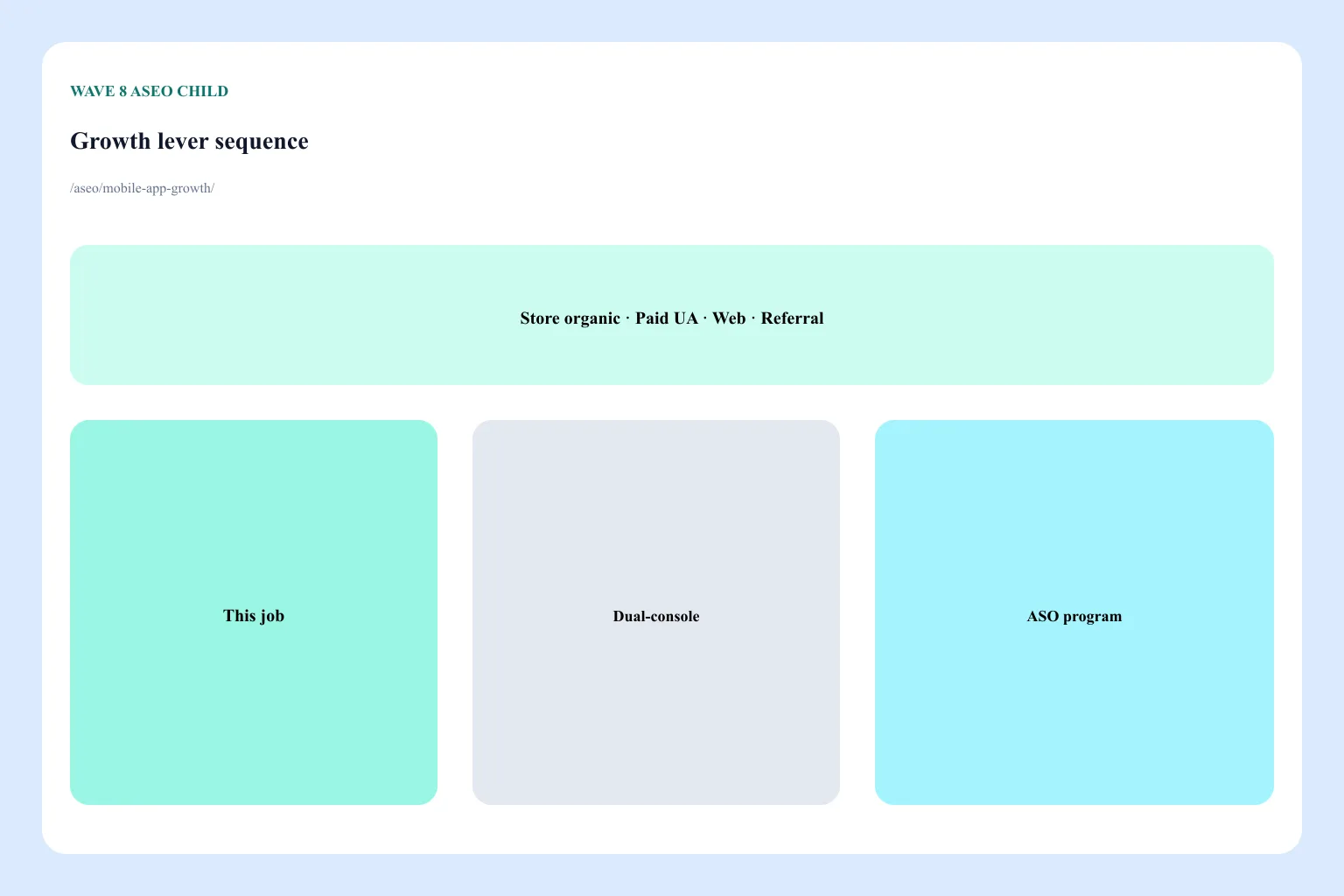
Delivery sequence
Store-organic listing work is the foundation when the job is store search. Depth stays on ASO children, not a second hub.
Paid UA is a /ppc/ door — campaign structure does not live here.
Web-to-app is a /seo/ door — cluster inventory does not live here.
Referral and invite loops are growth tactics the ASO hub refused as spine.
Retention is a constraint on promotion honesty, not a D1/D7 product.
Store-organic foundation versus paid UA versus web-to-app versus referral. Handoff, not reprints. Not the hub ASO spine. Not GEO.
Journey map only. No rankings, traffic, or results claims.
Split
The ASO hub owns **store-search program**: Store demand → Metadata → Creatives → Ratings → Experiments. App store optimization owns **both consoles as one engagement**. PPC owns paid demand, including app campaigns if that is the paid job. SEO owns web documents and web-to-app pages as documents. This page owns **lever order**: when store-organic is first, when to open paid, when to open web, when referral is in play — and what this URL must not reprint.
Counterpart: Store-search ecosystem map · dual-console calendar · Google Ads / ASA structure · web clusters.
This page: A sequence of growth levers with named handoffs, not a second ASO essay.
Counterpart: Store demand → Metadata → Creatives · Play+Apple cadence · query auctions · URL systems.
This page: Foundation → paid door → web door → referral loops → retention as constraint.
Counterpart: ASO · PPC · SEO · app store optimization
This page: This growth-mix URL.
Foundation
Mobile app growth is **lever sequence**. When the honest job is store search and listing conversion, store-organic work is first. That work still lives on `/aseo/` children. This page does not become a second hub with Store demand → Metadata → Creatives.
If metadata, creatives, and ratings ops are unstaffed, paid UA will buy installs onto a weak listing. The fix is to open the ASO doors — metadata, screenshots, ratings — not to paste those spines here.
We will not invent a 40% organic mix, an LTV:CAC floor, or a category-rank guarantee as a growth SKU.
GEO and LLM “assistant recommends your app” packages are out. Frozen `/llm-seo/` stays parked.
Paid door
When the lever is paid user acquisition — including Apple Search Ads or Google App campaigns if that is the PPC job — this page **points**. Account structure, Quality Score, RSA, PMax, and YouTube units stay on frozen PPC and its children.
Listing conversion protocol that reads store funnel after a paid impression still sits on app conversion. Growth only decides that paid is **in the mix**, not how to bid.
We will not reprint Wave 7. We will not mint an ASA child URL.
Web door
When the lever is a website that sends people to the store or uses app indexing, this page **points** to SEO. Web titles, clusters, and technical access are not Apple keyword-field packing.
App indexing / association as a Play Console checkbox may be named on Google Play optimization. The **web documents** behind it stay on SEO.
A wrapper app does not turn the marketing site into ASO. Two objects: listing and URL.
Referral
Referral, invite, and credit loops can grow an installed base. The ASO hub refused them as the store-search spine. This URL may name them as a **lever** with product and policy constraints (no review-for-credit; that ethics refuse lives on ratings).
Deep links and deferred referral attribution are implementation with the product team. They are not screenshot storyboards and not Play listing experiments.
SMO share cards can carry an invite. Channel SEO stays on SMO. This page does not become a social retainer.
Retention constraint
If people churn immediately, amplifying store-organic or paid UA is an honesty problem. We treat retention as a **constraint** on how loud the mix can be. We will not sell D1/D7 targets as an ASO product.
Product quality loops from repeating one-stars still belong on ratings ops. Growth only says “do not scale the mix until the leak is named.”
Field notes
This page will not list every `/aseo/{slug}/` as if it were the hub directory. Two room siblings plus parent is enough; depth stays on those URLs.
Dual-console ship calendar is app store optimization, not lever order.
Keyword inventory is app keyword research, not a growth spreadsheet of web volume.
GBP local discovery is Maps. An app is not a storefront pin. Refusal: Google Business Profile.
We will not use “reduce paid UA” as a cloned FAQ. Mix can **include** paid; PPC runs it.
Featured App Store editorial is not a lever we sell as a placement product.
Cross-promotion of a second binary you own is a product decision. It is not screenshot H1 and not this mix by default.
Wear, TV, and kids apps change which levers are legal. That is a constraint, not a new URL.
International storefronts change paid and web doors per market. International PPC and international SEO remain those engines; this page only sequences the mix.
Custom Product Pages as paid destinations are conversion **vehicles** plus Apple OS — not growth reprinting Connect.
We will not blend store organic, paid, and web sessions into one invented “growth rate” SKU.
Lifecycle push and email are product comms. They are not store metadata and not this H1 unless they are the referral mechanic.
Hub Experiments family is listing tests. Scaling those tests is not a fourth ASO spine here.
Title renames as brand events can affect every lever. The string still lives on app title.
If implementation cannot keep this as mix-and-handoff, leave it supporting — do not fatten it into `/aseo/` chapter two.
Character limits, CPI floors, and organic-percentage targets are not products on this URL.
Depth
Growth lever sequence is the object of this page: the order of store-organic, paid UA, web-to-app, and referral, with retention as a constraint rather than an ASO treatise. It is not the ASO hub spine. It is not a second metadata OS. Growth lever sequence is mix and handoff.
Store-organic in the growth lever sequence is whatever Wave 8 children already own. This URL does not reprint titles, keyword fields, or screenshots. It only says whether store-organic is first, later, or paused. App store optimization still runs the dual-console calendar when both stores are in that organic lever.
Paid UA in the growth lever sequence is a door to frozen PPC, not Apple Search Ads as a minted slug and not a Google App campaign treatise on this H1. Growth lever sequence names when paid should wait until the listing is honest. It does not operate Quality Score or RSA auctions.
Web-to-app in the growth lever sequence is a door to SEO documents that can deep-link or explain the app, not store metadata. App indexing and web pages are not Play long description. Growth lever sequence refuses to write console fields. It only orders whether the site should precede store-organic work.
Referral in the growth lever sequence is an in-product loop, not a store listing experiment. Impression-to-install protocol stays on app conversion optimization. Referral may start after install. Mixing referral with listing CRO is how this URL would steal Room D. Growth lever sequence keeps referral as a later lever.
Retention as a constraint on the growth lever sequence means a leaky product does not get more paid UA as a substitute for fixes. We will not invent a lifetime-value ratio or an organic-share myth. Growth lever sequence can pause paid and even pause store experiments when the binary cannot keep people.
In-app review prompt APIs are not the growth lever sequence. App ratings and reviews own SKStoreReviewController, Play’s review API, and public replies. Ratings quality can constrain growth, but the mix page does not become prompt documentation. Handoff is one sentence. Ops stay on ratings.
Play Console listing experiments are not the growth lever sequence. Google Play optimization owns Play-native forms, custom store listings, and description indexing. Growth lever sequence may say not to buy Play traffic while a listing experiment is dirty. It does not configure those Play forms.
The App Store Connect keyword field is not the growth lever sequence. Apple App Store optimization owns Connect, including the hidden field and Custom Product Pages. Growth lever sequence may delay paid iOS conversations until that field and the title are honest. It does not pack commas.
Store query inventory is not the growth lever sequence. App keyword research lists honest queries. Mix does not discover queries. If inventory is empty, store-organic is not a lever you can pull yet. That finding is sequence, not research reprint.
Field allocation OS, visible title string, and Play/Apple listing copy objects stay on Room C. App metadata optimization, app title optimization, and app description optimization keep those jobs. Growth lever sequence only asks whether metadata is stable enough to spend against.
Screenshot storyboard assets stay on screenshot optimization. Growth lever sequence may delay paid creatives until store frames exist, because ads that promise a different product than the listing create refunds and one-star loops. That is order. It is not a storyboard.
Social-profile work is not the growth lever sequence. SMO owns profile discoverability. Align names if needed, then stop. Growth lever sequence will not become a content calendar. Maps listings are not app listings; GBP stays off this mix except as a refusal.
LLM and GEO retrieval are not the growth lever sequence. We will not sell “AI recommends your app” as a lever. Frozen LLM SEO stays citation work for documents. Growth lever sequence stays store-organic, paid UA, web-to-app, and referral in an order you can defend.
Growth lever sequence has no paid-install floor, invented rank, organic-share myth, or calendar sold as a product. The deliverable is an explicit order of levers, explicit pauses when retention or listing honesty fails, and doors into ASO children, SEO, and PPC instead of reprinting those engines on a fake second hub.
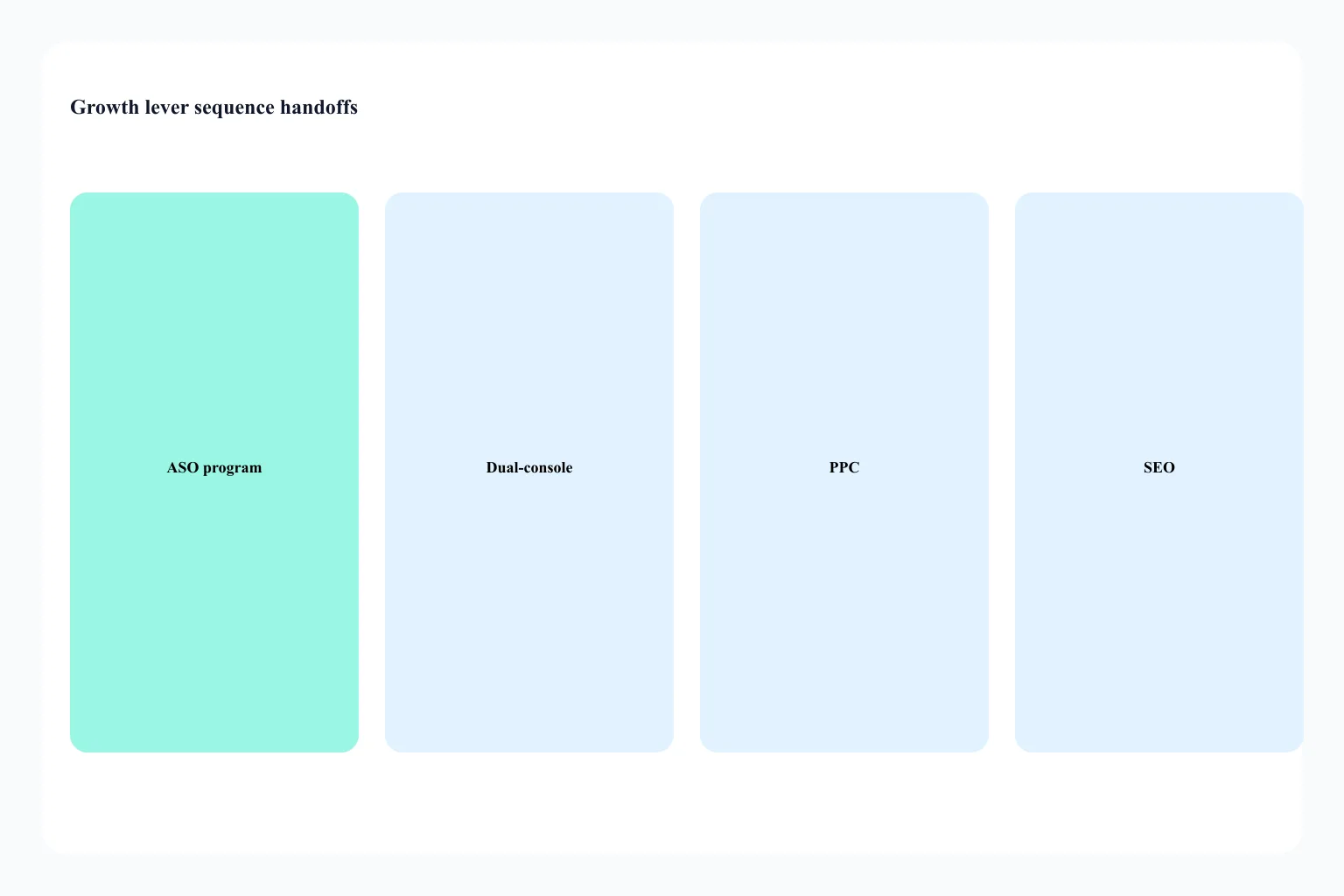
Sequence
Open ASO children. Do not reprint the hub spine here.
No campaign structure, no minted ASA slug.
No store-field packing on web documents.
No D1/D7 SKU. No 40% organic. No GEO.
Not this URL
Program map stays on /aseo/.
Frozen /llm-seo/ stays parked.
No invented mix percentage as a product.
Paid structure and web clusters stay on those hubs.
Explore
Questions
The hub maps store-search families and which child to open. This URL orders levers outside and beside store organic: paid UA, web-to-app, referral. It does not reprint Store demand → Metadata → Creatives → Ratings.
No. We do not invent organic mix % or LTV:CAC as products.
Paid structure lives on /ppc/. This page names when paid UA is in the mix. Dual-console organic cadence stays on /aseo/app-store-optimization/.
Web documents and clusters are /seo/. This page only sequences when a web path should feed the store listing versus when store organic should lead.
No. Referral is a growth lever here. Store listing families stay on /aseo/ and its children.
No. Retention is a constraint on whether paid or store tests are worth running. It is not an ASO treatise and not a retention-SKU.
App Growth
Integrated mobile app growth: ASO, paid UA coordination, retention metrics, and organic install scaling.
App Growth must name
App Growth next. Not a generic visibility score.