
Object
Counterpart: A grid dashboard · an evidence pack on your holds · a backlink profile · a field form.
This page: A dated gap table plus routes — no implementation, no rank promise.
GBP pack gap readout
Local competitor analysis at SEOConsultants.ai is a readout: named competitors, a named query set, and a gap table on listings and pack appearance — then a route to the child that owns the fix. It is not [Google Maps SEO](/google-business-profile/google-maps-seo/) operating your signals, not [GBP audit](/google-business-profile/gbp-audit/) of your duplicates, and not frozen [local SEO](/seo/local-seo/) comparing website documents as this H1.
Related page: Maps listing operation.
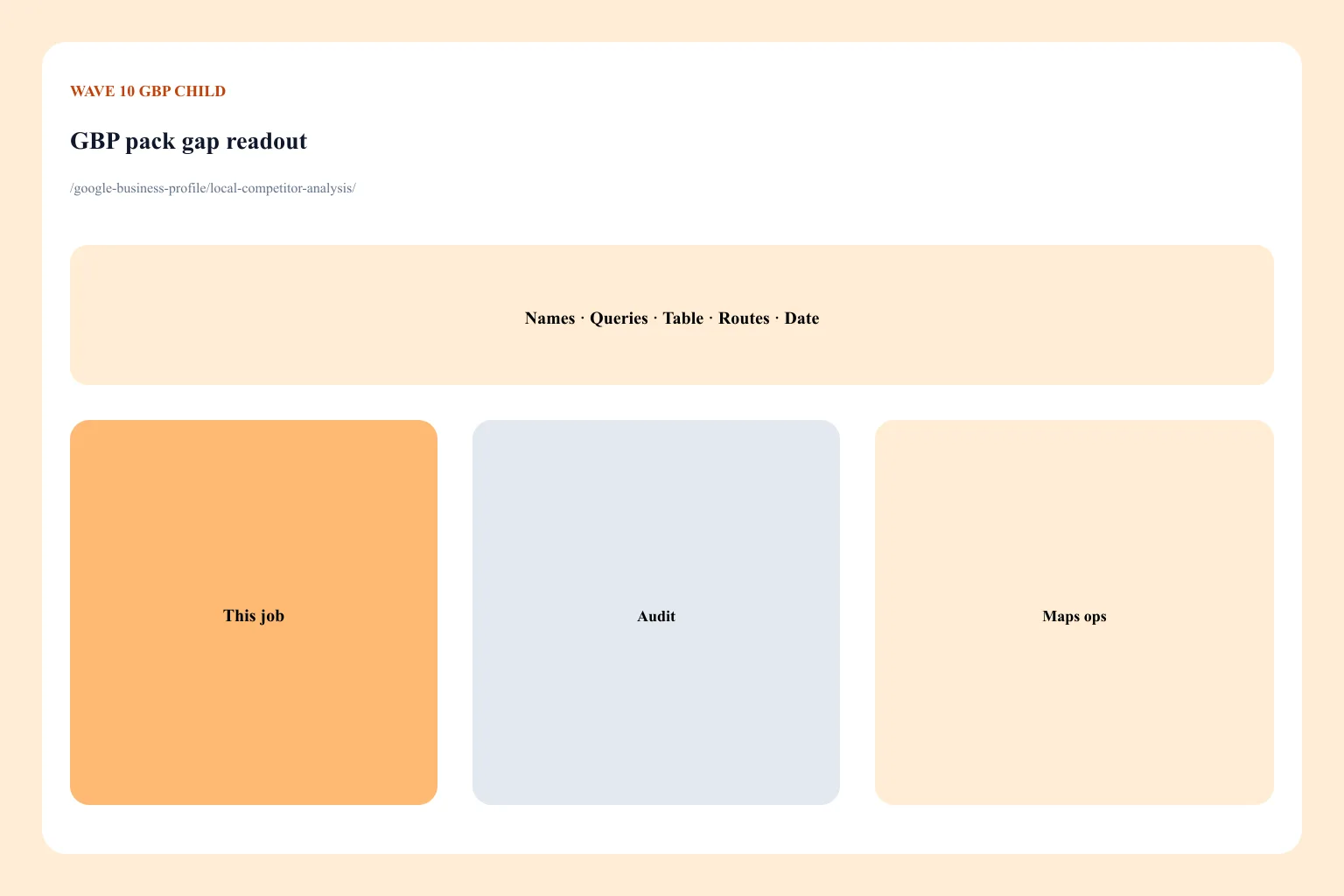
Delivery sequence
Competitors who actually occupy the pack for agreed queries — not an invented chain list.
Query set you will stand behind. Not every “near me” variant as a SKU.
Gaps: reviews, photos, categories, citations, posts — listing objects only.
Each gap routes to the child that owns the fix. This URL does not implement.
Artifact has a date. No monthly competitor SLA.
Table and routes. Not operating your Maps signals. Not diagnosing your duplicates as the spine.
Journey map only. No rankings, traffic, or results claims.
Split
Google Maps SEO operates *your* listing signals. GBP audit diagnoses *your* duplicates and holds. Website competitors stay with local SEO when the object is HTML. This page is the **gap table**.
Counterpart: A grid dashboard · an evidence pack on your holds · a backlink profile · a field form.
This page: A dated gap table plus routes — no implementation, no rank promise.
Counterpart: Proximity/grid · merge path · location URLs · completeness.
This page: Names → queries → table → routes → date stamp.
Counterpart: Maps · audit · reviews · citations
This page: This readout URL.
Scope
Local competitor analysis on this URL is a readout of other listings versus yours on named queries, then routes to the child that owns each gap. It is not Maps operations and not your duplicate audit.
Buyers want to know why a rival sits in the pack. The answer is a **table**, not a second Maps OS. Implementation stays on siblings.
A paragraph that still works after swapping this H1 for “Google Maps SEO” is deleted.
A paragraph that still works after swapping for “GBP audit” is deleted. Your second pin is diagnosis. Their extra photos are a gap.
We will not invent review-velocity targets or “reviews needed” as a SKU. The table can show a count difference as a fact. The ask system is review management.
Queries
Core service plus geography you serve. Not a dump of every neighborhood string as doorway bait.
City landings stay off this URL. Wave 5 markets stay frozen.
National chains appear only if they occupy those results.
Franchise scale advantages are notes, not a franchise-RACI treatise — that is franchise SEO.
Table
Categories, photos, posts, review counts as observations, citation presence as observations. Website modules and organic backlink profiles are not this H1.
Q&A and photo quality can be rows. Editorial corpora stay on local-content as the fix route.
We will not scrape in a way that becomes a productized spy SKU. The artifact is enough to route.
Pack position numbers are observations on a date, not SLAs.
Routes
Category gaps → optimization. Review gaps → review management. NAP gaps → citations. Post theme gaps → local-content. Duplicate of *you* → audit.
Maps operation receives “operate after the gap is closed,” not the table as its spine.
Local SEO receives site-only gaps in one sentence.
We do not rewrite listings during the readout.
Honesty
Not a monthly subscription that reprints Maps SEO.
Not AI-local competitor products.
Not App Store competitor ratings.
Not social follower comparisons.
Readout notes
Query-set version IDs belong on the artifact. Grid dashboard versions belong on Maps SEO.
A rival’s duplicate listings are their problem unless they confuse your NAP — then citations or audit.
We refuse “top 3–5” as a cloned FAQ from leftover copy; the set is whoever occupies the agreed queries.
Emerging challengers are extra rows only when they appear.
Multi-city brands get one artifact per market, not a Wave 5 rewrite.
Franchisee-ready PDFs are formatting, not franchise law.
We will not include organic SERP competitors as the spine.
Date stamps prevent treating a stale table as live operations.
Depth
GBP gap readout is the object of this page: named competitors who occupy agreed queries, a listing-only gap table, and routes to the child that owns each fix. It is not Maps operations. It is not your duplicate audit. GBP gap readout does not implement.
Google Maps SEO operates your signals and dashboard. GBP gap readout will not run the grid as its spine. A paragraph that still works as Maps SEO is deleted here.
GBP audit diagnoses your holds and second pins. GBP gap readout diagnoses theirs versus yours. Mixing those leftover clones turns every local page into “why we don’t rank.”
Frozen local SEO may compare websites. GBP gap readout will not take organic backlink profiles as the H1. Listing objects only: categories, photos, posts, review observations, citation observations.
GBP optimization receives category gaps. GBP gap readout does not fill fields during the artifact. The table is not a completeness pass.
Review management receives review gaps as routes. GBP gap readout will not sell a reviews-needed SKU. A count difference is a fact on a date.
Local citation building receives NAP gaps. GBP gap readout will not submit directories as the method.
Local content receives theme and photo-story gaps. GBP gap readout will not write Posts during analysis.
GBP management may later publish. GBP gap readout is not a management month.
Franchise SEO owns listing RACI. GBP gap readout may note a chain in the pack. It will not draft territory law.
Multi-location SEO may get one artifact per market. GBP gap readout will not rewrite Wave 5 cities.
GBP services still chooses the channel. GBP gap readout does not reprint the hub map as a competitor essay.
App Store and social follower comparisons are refused. Those surfaces are ASO and SMO. GBP gap readout stays Maps listings.
We will not invent a monthly competitor SLA. Repeat when queries or doors change. Date stamps keep the table from pretending to be live operations.
GBP gap readout has no implementation, no pack invoice, and no website-SEO spine. The deliverable is a dated table plus routes, with Maps, audit, and local SEO left on their doors.
A query-set version ID on the GBP gap readout keeps the artifact honest. Last quarter’s table is not this week’s Maps operation. Date stamps are part of the object.
National chains appear on the GBP gap readout only when they occupy the agreed results. Inventing a chain list that is not in the pack is leftover theater.
Website module comparisons are refused as the spine of the GBP gap readout. If the rival’s location HTML is the only gap, that row routes to local SEO in one sentence and this H1 stops.
We will not scrape rivals into a spy SKU on the GBP gap readout. Enough rows to route is enough. Implementation still happens on siblings.
Franchise-ready PDF formatting is not franchise law on the GBP gap readout. Ownership of listings stays on franchise SEO. The table can still name who sits in a market.
App Store screenshots of rivals are refused. ASO stays frozen. The GBP gap readout is Maps listing objects.
Social follower counts are refused on the GBP gap readout. SMO community is not this artifact.
Emerging challengers are extra rows only when they appear for the locked queries. They are not a reason to reprint Maps operations.
Multi-city brands get separate GBP gap readout artifacts per market. They do not get Wave 5 rewrites. They do not get a single blended pack story that hides a weak door.
We refuse a monthly competitor subscription that is actually Maps SEO wearing a table. Repeat when doors or queries change. Otherwise the dated artifact stands.
Pack position numbers on the GBP gap readout are observations on a date, not SLAs. Implementation still routes. This URL does not operate your grid.
A rival’s duplicate listings are their problem on the GBP gap readout unless they confuse your NAP — then citations or listing diagnosis, not a spy SKU.
Named query sets you will not actually use are refused. Neighborhood doorway bait is not a GBP gap readout object.
The GBP gap readout needs one more honest stop: it does not rewrite listings. Category gaps go to GBP optimization. Review gaps go to review management. This artifact stays a table.
If the only gap is location HTML, the GBP gap readout writes one handoff to local SEO and ends. Website competitors are not this H1. Pack occupancy of listings is.
A stale GBP gap readout is not live Maps operation. Google Maps SEO keeps the dashboard. This URL keeps the date. Mixing them reprints leftover “why we don’t rank” clones.
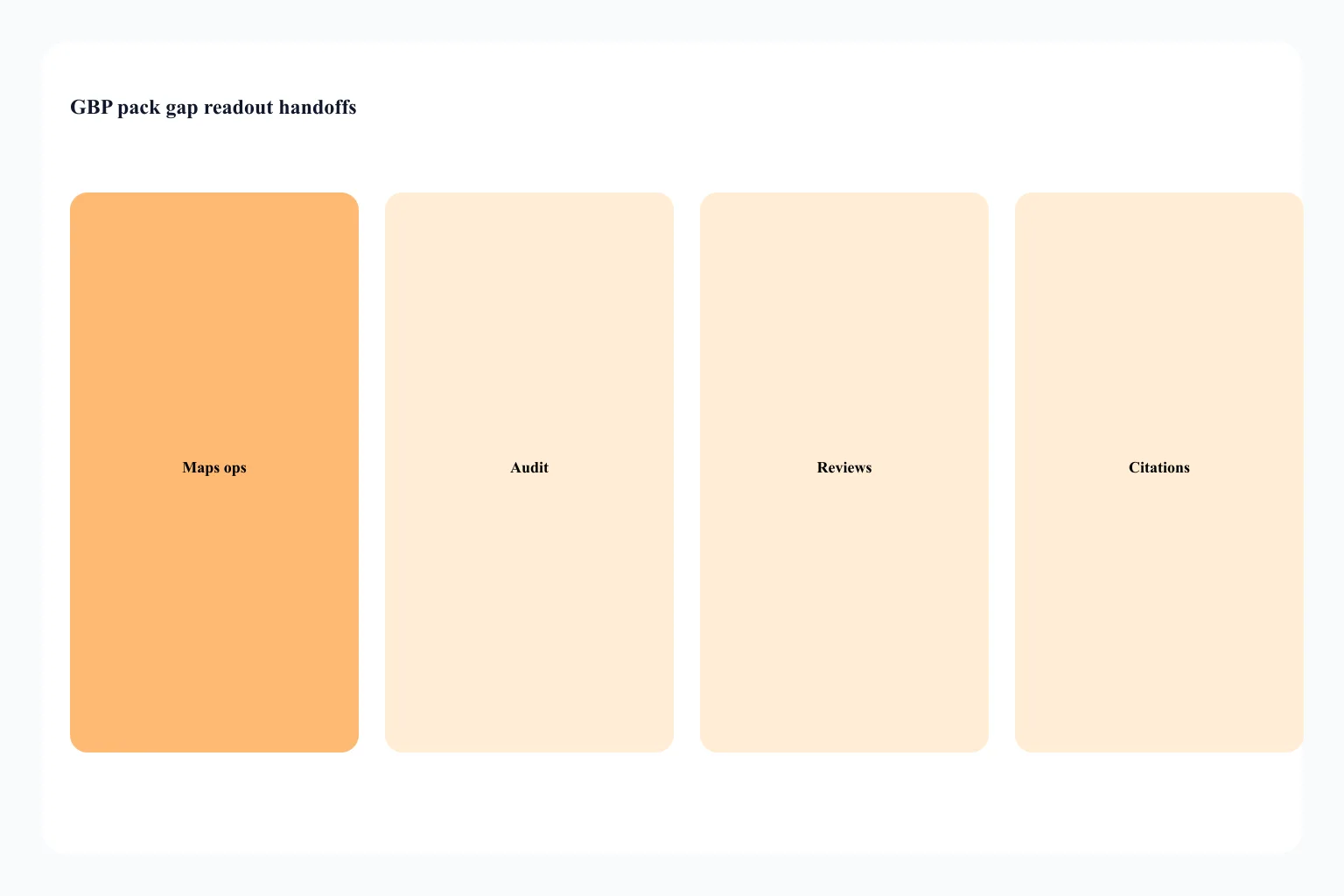
Sequence
Who occupies results you care about.
No website backlink theater as this H1.
Implementation is never this URL.
Repeat only when doors or queries change.
Not this URL
Grid dashboards and proximity constraints are Google Maps SEO.
Duplicates and holds of your profiles are GBP audit.
HTML competitors stay off this H1.
Fields, reviews, and citations execute elsewhere.
Explore
Questions
The readout names who appears and which listing fields or reviews differ. Operating your own Maps signals is [Google Maps SEO](/google-business-profile/google-maps-seo/). We will not run your grid dashboard as this H1.
No. Fixes route to [GBP optimization](/google-business-profile/gbp-optimization/), [review management](/google-business-profile/review-management/), citations, or local content. The artifact is the table and the routes, not implementation.
[GBP audit](/google-business-profile/gbp-audit/) is evidence about *your* listings. This URL is about *theirs* versus yours on named queries. A rogue duplicate of your door is audit, not competitor strategy.
No. Site-side competitive work belongs with frozen local SEO or other SEO children. This readout stays GBP photos, categories, posts, reviews, and citation *gaps* as listing objects.
It is an artifact with a date. Repeat only when the query set or the set of doors changed. We will not sell a monthly “competitor SLA” or invented review-velocity targets.
We can name who actually occupies the pack for the agreed queries. We will not invent a national-chain theater that is not in those results, and we will not turn franchise legal RACI into this page.
Local Competitors
Local competitor analysis: map pack benchmarks, GBP comparison, review gaps, and citation authority assessment.
Local Competitors must name
Local Competitors next. Not a generic visibility score.